
Edwardian Hair Pins: What They Held, What They Showed
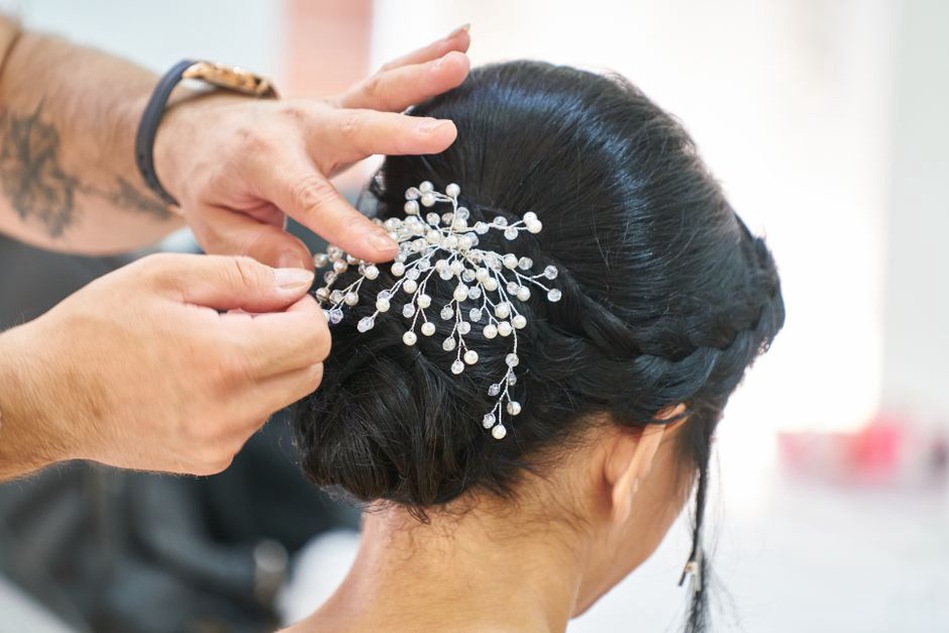
The jewelled pin above an Edwardian bun caught the light; the plain steel pins underneath did the harder work. Raised hair needed support from hairpins, combs or pads before an ornament could sit securely. When looking at a surviving accessory, it helps to ask whether it held the style together or was meant to be seen.
Two kinds of pin, one elaborate hairstyle
In Britain during Edward VII’s reign, from 1901 to 1910, fashionable hair often looked full and softly lifted rather than tightly drawn back. The familiar Gibson Girl silhouette appeared in illustrations and fashion, though no single arrangement suited every wearer or occasion. Hair might be swept over a pad, gathered into a chignon and secured with U-shaped pins. A long ornamental pin could then be slipped through the finished style.
A working hairpin grips as its two prongs flex slightly against the hair. A decorative pin may depend more heavily on the structure beneath it. Hatpins had another job: their long shafts passed through a hat and into dressed hair to keep the hat in place. Calling all three simply “pins” can obscure both their original purpose and how safely they can be worn now.
What the materials reveal
Plain steel pins were everyday equipment, inexpensive enough to replace when they bent or vanished. Decorative heads came in silver, gilt metal, carved horn, celluloid, glass paste and imitation pearls; precious stones appeared at the costly end. A pin that looks like tortoiseshell or ivory cannot be identified by appearance alone. Early plastics and other imitations were made to resemble more expensive materials. Mounting, weight and wear offer clues, but an uncertain piece deserves a cautious description.
Ornament did not have to mean gemstones. Pierced metalwork let light through a design, while paste stones sparkled under evening illumination. Seed pearls and floral motifs softened the outline of a dark updo. A surviving matched pair may have been displayed on either side of a style, but a single pin is not necessarily the stray half of a set. Losses, changing fashions and later repairs have all affected what survives.
Glamour depended on time, money and labour
Fashion plates and formal portraits show the finished hairstyle, not much of the work behind it: dressing long hair, arranging pads, placing pins and keeping a hat steady outdoors. Women with servants might have help; others did their own hair or visited a hairdresser when circumstances allowed. A lavish illustrated coiffure was not every British woman’s morning routine.
Price shaped the effect, too. A precious-metal ornament could signal wealth, while an affordable imitation gave a similar look for less. Imitation materials were part of Edwardian dress, not simply a poor substitute for the “real” thing. A shop assistant, teacher or typist might choose a modest decorative pin for an occasion but rely on unobtrusive fixings at work. Practices varied, and a photograph alone cannot establish someone’s occupation or income.
Occasion mattered. An ornament suited to evening dress might look conspicuous with practical daytime clothes, while an outdoor hat could conceal much of the hairstyle. These were questions of context, not fixed rules about who was “allowed” to wear a particular pin. One person could own plain working pins, a hatpin and a cherished ornament, each with its own purpose.
The hatpin’s sharper edge
Large Edwardian hats could call for long hatpins. On crowded streets and transport, exposed points became a public concern; guards or covered tips reduced the risk of catching another passenger. Reports and local rules varied, so there was no single hatpin law shared by every British town. The practical point is plain enough: a long shaft belongs to the history of hats as well as hair, and its tip needs protection.
That matters to collectors who want to wear their finds. A decorative head does not make a long, pointed shaft an ordinary bun pin. Check its length and tip, and look for a secure guard before trying it on. Never push an antique hatpin towards the scalp or leave its point projecting beyond a hat or hairstyle.
Reading an Edwardian pin without over-dating it
Start with construction, then consider style
A swirling floral head or imitation pearl may look Edwardian, but such motifs lasted into later decades and have since been revived. Start where the head meets the shaft: is it firmly attached, soldered, screwed on or held by a later adhesive? Compare wear on both parts. A bright new shaft beneath a worn ornament may be a replacement.
- Check the intended use: short paired prongs suggest a hairpin; a long single shaft may be a hatpin. The decorative head alone will not settle it.
- Inspect the point and finish: rough edges, flaking plating or a loose setting can snag fabric and hair.
- Describe materials conservatively: “pearl-effect bead” is more accurate than “pearl” if the material has not been verified.
- Keep any provenance: an old box or family note adds context, though it cannot prove that every piece inside began together.
Maker’s marks and hallmarks can help identify a silver-mounted piece, but not every pin was marked, and a marked head may have been moved to another shaft. Edwardian-style does not necessarily mean Edwardian-made. For an expensive purchase, ask for clear photographs of the reverse, the join and the entire shaft, as well as the decorative front.
Wearing one without recreating the whole coiffure
A small ornament works above a low twist or beside a simple bun; there is no need for a pad, pompadour or period costume. Secure the hair with modern, unobtrusive pins first, then add the antique piece as a finishing detail unless its construction is demonstrably sound enough to bear weight. That spares an old join unnecessary strain while preserving the distinction between support and display. A pearl-effect pin against a dark knit, for instance, needs little competition at the neckline.
In storage, keep pointed shafts apart so they cannot scratch delicate heads, and do not force a bent pin straight. If a setting moves, stop wearing the ornament until a suitable conservator or experienced repairer has assessed it. A label on its tray—working hairpin, ornamental pin or guarded hatpin—will make it easier to choose and handle the piece next time.