
The Emily Lace Collar: An Edwardian Hair Accessory Guide
What Is the Emily Lace Collar?
The Emily Lace Collar is a distinctive Edwardian hair accessory that sits at the nape of the neck, draped over a low chignon or tucked under a chignon cap. Its name likely dates from the early 1900s, when Edwardian hairstyles favoured soft, feminine ornamentation that echoed the high-necked lace collars of women's blouses. You might come across it at Portobello Road or in an online estate sale from a Cotswolds manor, catalogued as a "lace hair piece," "Emily collar slide," or simply "vintage lace fall."
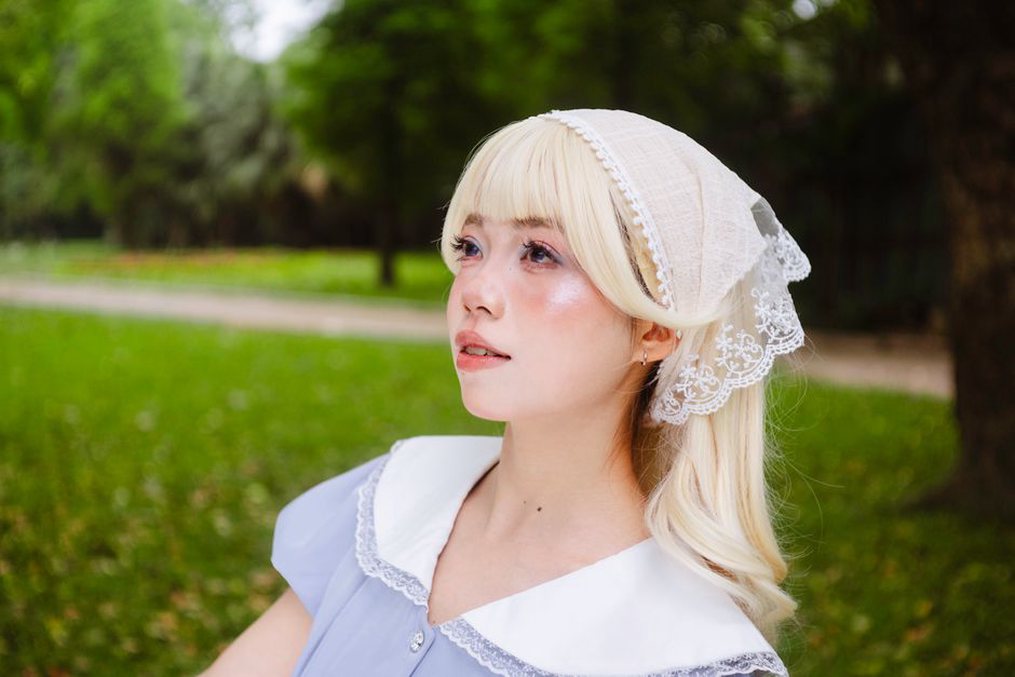
The Origins of the Lace Collar Hair Accessory
In the late 1890s and into the first decade of the twentieth century, women's hair was worn in voluminous pompadours and chignons, often decorated with ribbons, combs, and small hats. The lace collar as a hair ornament emerged from the same aesthetic that prized delicate handcraft: if a blouse had a lace collar, why not mirror that collar in the hair?
Craftswomen in London and Paris began to make separate, detachable lace collars that were pinned or sewn onto a velvet ribbon or a small wire frame. These were then fastened with two or three hidden pins into the hair. The most famous surviving examples are made of Irish crochet lace or point de gaze, but many British domestic pieces were worked in Cluny or Bedfordshire lace. The Emily Lace Collar specifically refers to a style with a scalloped outer edge and a narrower inner band that sits flush against the skin, mimicking the shape of a 1890s dress collar.
Materials and Construction
Authentic vintage Emily Lace Collars (circa 1900–1920) are almost always handmade. The lace itself is worked in fine cotton or silk, often in cream, ecru, or black. The collar is typically backed with a thin layer of silk netting to protect the hair from snagging, and it may have a short length of fine wire inserted along the curved edge to help it hold its shape.
- Crochet Lace: Dense, textured patterns – often floral or geometric – that give the collar a sturdy but supple feel.
- Needle Lace (Point Lace): Finer and more delicate, with open spaces and motifs that are individually sewn. These are rarer and command higher prices.
- Machine-made Lace: From the 1920s onward, some collars were mass-produced on Leavers or Nottingham lace machines. While still collectible, they lack the weight and drape of handwork.
The original fastening method was a set of two or three small metal hairpins that were stitched to the back of the collar. Many collars lost these pins over time, which is why you often see them sold as "pins missing" – but a simple restitching with modern hair pins (or small alligator clips) can bring them back to life.
Distinguishing a True Vintage Emily from Later Reproductions
Because the Emily Lace Collar is relatively obscure, reproductions are less common than for, say, a Victorian comb. Still, copies exist, and knowing how to spot a genuine piece is essential for the discerning collector.
| Feature | Genuine Vintage (Pre-1920) | Reproduction (Post-1970) |
|---|---|---|
| Stitch density | Very high, uneven by hand; lace pattern has slight irregularities | Even machine stitch; perfectly uniform |
| Backing fabric | Silk net or fine cotton; may be hand-stitched to lace | Polyester net or synthetic tulle |
| Color | Warm ivory, ecru, or off-white that yellows evenly with age | Bright white or uniform cream with no gradient |
| Pins | Original pins are black steel or brass, often tarnished | Shiny new silver-toned metal |
If you find a collar with a label reading "Made in Occupied Japan" or "Hong Kong" it is likely a later souvenir piece from the 1950s–60s – still attractive, but not an Edwardian Emily.

How to Style the Emily Lace Collar Today
The key to wearing a vintage lace collar with contemporary clothes lies in contrast. A crisp white shirt or a simple cashmere sweater provides a clean backdrop that allows the lace to speak. Here are three practical ways to incorporate it:
- The Low Chignon Anchor: Gather your hair into a loose bun at the nape. Position the collar so its curved edge sits just below the bun, and secure with U-shaped hairpins through the back netting. Let a few tendrils escape for softness.
- The Half-Up Tuck: Clip the collar onto a velvet headband (using small alligator clips) and then wear the headband like a classic headband – the lace will act as a decorative band that frames the face.
- Bridal Accent: Sew the collar onto a small hair comb (a fine metal comb with a crest) and wear it at the crown. This works wonderfully with a modern sheath dress or a 1920s-style slip.
For more on how other vintage hair accessories can complement a modern silhouette, our article on The Red Velvet Crown: A Century of British Hair Accessory History explores the evolution of statement pieces from the same era.
Care and Preservation
An original Emily Lace Collar is delicate. Never machine wash it. Instead, place it flat on a clean towel and dab with a solution of lukewarm water and a drop of mild washing-up liquid. Rinse by dabbing with distilled water. Do not wring. Reshape the collar while damp and let it dry on a clean towel away from direct sunlight. Store it flat in acid‑free tissue paper, not folded, and avoid hanging it (the weight can stretch the lace). If the original pins have rusted, remove them with tweezers and replace with stainless steel hairpins from a haberdashery.
Where to Find an Authentic Emily Lace Collar
These pieces appear most often in UK antiques fairs, particularly those specializing in textiles. Look for stalls run by elderly dealers who focus on white work and lace. Online, search for "edwardian lace hair collar," "1900 crochet hair ornament," or the French term "collerette de cheveux." Expect to pay between £30 and £120 depending on condition and lace quality.
One final tip: when examining a collar in person, hold it up to the light. Genuine hand-made lace will show slight variations in the thickness of the thread and the size of the loops. That irregularity is not a flaw – it is the signature of a real Emily, made by a pair of hands more than a century ago.