
The Silent Language of Edwardian Hair Accessories
A single tortoiseshell comb could communicate more about a young woman's social standing than a spoken introduction. In the crowded ballrooms of Edwardian London, where chaperones watched from velvet settees and the air was thick with the scent of hothouse roses, hair accessories functioned as a silent language of wealth, taste, and marital eligibility. The difference between a paste rhinestone bandeau worn for afternoon calling hours and a diamond-encrusted tiara reserved for Court presentations was not merely a matter of cost—it represented a rigidly codified system of etiquette that governed every hour of a debutante's day.
The Grammar of Ornament: Daytime Propriety
For morning calls and garden parties, the rule was restrained elegance. Wide velvet ribbon headbands, known as bandeaux, sat low on the forehead and were often trimmed with a single ostrich plume or a small cluster of silk flowers. These pieces were deliberately modest; a young woman who appeared at a charity bazaar wearing a comb dripping with paste brilliants would have been quietly judged as vulgar. The most prized daytime accessories were hand-carved from genuine blonde tortoiseshell, their surfaces polished to a deep, translucent warmth that no modern acetate has ever fully replicated. A well-chosen comb with delicate floral piercing indicated that its wearer understood the distinction between afternoon ornament and evening opulence.
Practicality also shaped the silhouette. Hair was dressed high and wide, anchored by back combs with long, sturdy teeth that gripped the elaborate pompadours and Gibson Girl rolls without slipping. These combs were often made from unadorned horn or dark shell, their beauty lying entirely in the curve of the top edge and the quality of the cutting. A collector today can identify an authentic Edwardian day comb by the irregular spacing of its teeth—each one hand-cut with a fine saw, never perfectly uniform like a machine-moulded reproduction.
Theatre, Supper, and the Ballroom: The Ascent to Brilliance
As gaslight gave way to electricity in the grand houses of Mayfair, the nature of hair ornamentation transformed completely. Evening events demanded sparkle, and the jewellery houses of the period—Garrard, Asprey, and the Parisian firm Cartier—responded with creations that blurred the line between hair accessory and fine jewellery. The aigrette, a feathered spray of diamonds or pearls set on a trembling wire spring, was the most coveted ornament of the era. Originally inspired by the plumes of egrets imported from India, the aigrette quivered with every movement, catching the light from chandeliers and drawing the eye directly to the wearer's face.
For a formal ball, a young woman might wear a dog-collar choker of pearls that continued upward into a matching hair ornament, creating an unbroken line of luminosity from throat to crown. This visual continuity was intentional; it elongated the neck and contributed to the swan-like silhouette that Edwardian society prized. The pearl-embellished velvet headband, while simpler than a full parure, offered a similar effect for a young woman attending her first season of private dances. Its dark velvet base disappeared against dark hair, leaving only the pearls visible, as though they were floating in the coiffure.
The Tiara Threshold
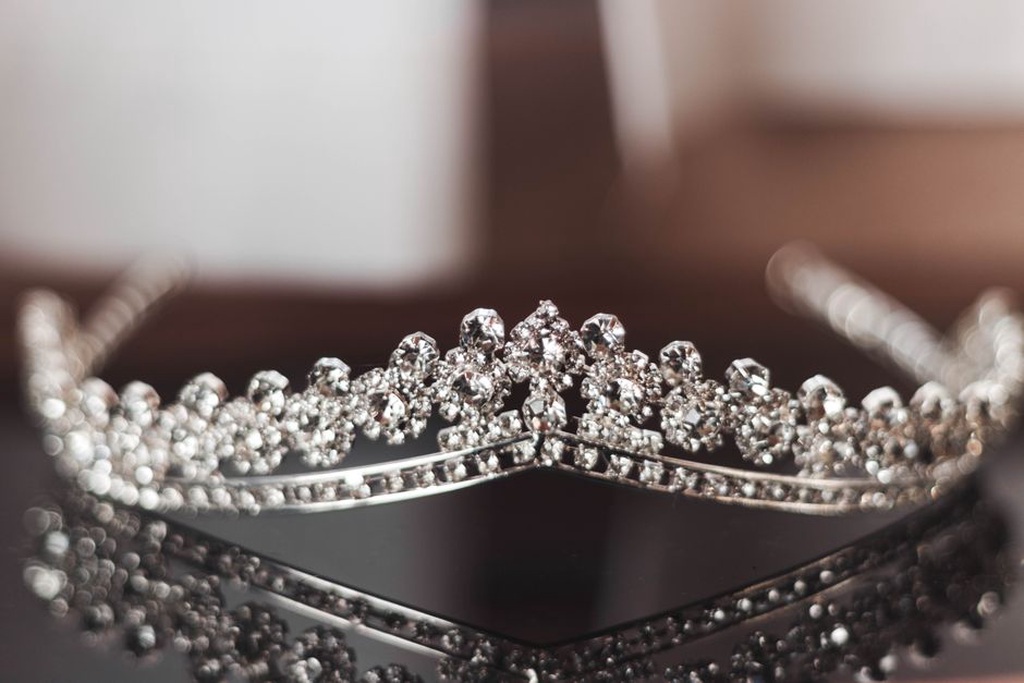
The tiara occupied a category of its own, governed by rules so precise that a misstep could result in social exclusion. Tiaras were reserved exclusively for married women and debutantes being presented at Court. An unmarried girl attending a country house weekend would never appear in a tiara—she would instead wear a bandeau of fresh flowers or a simple velvet ribbon threaded with a single strand of family pearls. The moment a bride married, however, she crossed the threshold into tiara territory, and her first appearance in one, often the family's heirloom piece, was a carefully observed rite of passage. These pieces were constructed with a lightweight frame of silver or gold, set with rose-cut and old-mine diamonds, and designed to be dismantled into separate brooches and hair pins for less formal occasions.
Mourning and the Language of Restraint
An entire parallel vocabulary existed for periods of bereavement, which were frequent and prolonged in Edwardian society. The elaborate etiquette of mourning extended to every visible accessory, including those in the hair. During deep mourning, all shiny surfaces were banished. Jet—a dense, black fossilized wood that could be carved into intricate shapes and polished to a deep, sober lustre—became the primary material for combs, hair pins, and barrettes. A widow in her first year of mourning would wear a jet comb with a simple, unadorned top edge, often paired with a black crêpe veil that covered the hair entirely.
As mourning lightened into half-mourning, the restrictions eased incrementally. The widow might introduce a comb of bog oak or vulcanite, materials that were black but less sombre than jet, perhaps with a small carved motif of a forget-me-not or a coiled fern frond. Grey pearls and muted amethyst were also permitted at this stage. These transitional pieces are now among the most fascinating finds for collectors, as they reveal a sensitivity to emotional nuance that modern fashion has largely abandoned. A jet comb with a single seed pearl at its centre tells a very specific story: the wearer was moving toward the light, but still bound by the strictures of grief.
Materials and the Hierarchy of Value
The material hierarchy of Edwardian hair accessories was both visible and tactile. At the pinnacle stood blonde tortoiseshell, sourced from the hawksbill sea turtle, which was valued for its warm, mottled translucency and its ability to be heated and moulded into three-dimensional forms. Below it ranked horn, which could be dyed to imitate tortoiseshell but lacked its depth of colour; celluloid, an early plastic that could be convincingly patterned to resemble shell or ivory; and gutta-percha, a rubber-like substance used primarily for mourning pieces. A trained eye can distinguish true tortoiseshell from its imitators by looking for the subtle overlap of translucent amber and dark brown patches—a depth that printed celluloid cannot reproduce. When examining a piece today, a gentle rub with a soft cloth will release the faint, organic scent of heated horn or shell, a sensory clue that no synthetic material can mimic.
Construction Details Worth Knowing
The internal architecture of an Edwardian hair ornament is as revealing as its exterior. Quality pieces used a three-pronged hinge on tiaras and bandeaux, allowing the frame to conform to the curve of the head without pinching. Combs were often constructed with a double row of teeth—longer ones for anchoring into the hair's core, and shorter ones near the top edge for gripping the surface layers. The finest examples have teeth that are slightly flexible rather than rigid; this springiness, achieved by careful hand-thinning of the horn or shell, prevents breakage and makes the comb comfortable to wear for hours. These structural refinements are almost never found in modern reproductions, which is why a well-preserved Edwardian comb can still be worn securely in a contemporary updo without the need for additional pins or elastics.
For those who appreciate the lineage of these pieces, a faux pearl and wood hair choker from a later era demonstrates how the Edwardian impulse to connect neck and hair ornamentation continued to resonate through the twentieth century. The materials evolved—wood replacing horn, faux pearls standing in for genuine orientals—but the fundamental silhouette remained recognisable.
Caring for Edwardian Hair Accessories Today
These pieces require a different approach to storage and cleaning than modern costume jewellery. Tortoiseshell, horn, and early plastics are hygroscopic, meaning they absorb and release moisture from the air. Storing them in an airtight plastic bag is one of the fastest ways to cause irreversible damage; the material will dry out, become brittle, and eventually crack along the grain lines. Instead, wrap each piece in unbleached cotton or acid-free tissue and store it in a wooden or cardboard box that allows air to circulate. A small dish of water placed in the storage area during dry winter months can help maintain the ambient humidity that these organic materials need to remain supple.
Cleaning should be minimal. A soft, dry brush—a clean makeup brush with natural bristles works beautifully—can remove dust from carved crevices without scratching the surface. Avoid water, alcohol, and commercial jewellery cleaners entirely. If a piece of horn or tortoiseshell has become dull, a microscopic amount of pure mineral oil applied with a cotton bud and immediately buffed off with a soft cloth can restore a gentle lustre. Never attempt to polish a piece with abrasive compounds; the patina that Edwardian accessories have developed over a century is part of their history and their value.