
How to Identify Authentic Art Deco Hair Clips: Materials, Clasps, and Geometry
A genuine Art Deco hair clip rarely announces itself with a label. More often, it whispers through the geometry of its silhouette, the weight of its clasp, and the particular way light moves across a carved piece of galalith. The period between 1920 and 1935 produced accessories governed by a strict visual language—symmetry, stepped arches, fan motifs, and the confident use of negative space. Understanding these structural principles is the first step in distinguishing a piece born from the Deco era from a later interpretation that merely borrows its mood.
The Grammar of Deco Geometry
What makes a hair clip authentically Art Deco is not simply a sunburst or a chevron. It is the discipline with which those elements are arranged. Authentic designs favour balanced asymmetry within a rigid frame: a central marcasite panel flanked by two elongated baguette-cut glass stones, or a celluloid clasp where a single carved lotus rises from a stepped ziggurat base. The lines are crisp, never hesitant. Curves exist sparingly, usually as a single perfect arc anchoring an otherwise angular composition.
Machine-age motifs dominate. Look for the visual vocabulary of skyscrapers translated into miniature—setbacks, parallel grooves, and tiered pinnacles. A common authentic detail is the "sunrise" fan, where graduated spokes radiate from a flat horizon line, often rendered in silver-tone metal with tiny pave-set rhinestones. Replicas tend to soften these hard edges, rounding corners that should be sharp, or overcrowding the design with additional floral flourishes the period would have considered superfluous.
Materials That Tell a Story
The materials of authentic Art Deco hair clips are a direct reflection of interwar technological optimism and scarcity. Galalith, a casein-based plastic invented in 1897, reached its aesthetic peak in the 1920s. It could be cut, carved, and dyed to imitate jade, coral, or lapis lazuli, yet it retains a distinctive warm, matte surface that modern acrylic cannot convincingly replicate. Run a fingertip over the surface of a suspected galalith piece: genuine examples feel slightly silky, almost organic, and warm quickly to body temperature. Modern resin stays cooler and feels glassier.
Celluloid, another early plastic, was often used for inexpensive Deco combs and side clips. It accepted brilliant amber, tortoiseshell, and emerald dyes, but it is inherently unstable. Authentic celluloid often shows a faint smell of camphor when rubbed gently, and under magnification, its surface may display tiny hairline cracks known as crazing—a natural aging pattern that modern plastics struggle to mimic without looking artificially distressed.
Metal findings provide another diagnostic layer. During the Deco period, rhodium plating became fashionable for its tarnish-resistant, icy-white finish that complemented diamonds and crystal. A genuine rhodium-plated clip has a cool, slightly grey luminosity, distinct from the bright blue-white of modern chrome. Brass findings were often stamped with fine geometric engraving and left unlaquered, developing a soft, dark patina in recessed areas over decades. A replica might use chemical antiquing that looks muddy rather than layered.
Clasps, Hinges, and the Architecture of the Back
The reverse side of a hair clip is frequently more revealing than the front. Authentic 1920s and 1930s pieces employed specific findings that evolved alongside changing hairstyles. The simple slide barrette—a flat metal band that snaps under a hook—was ubiquitous for bobbed hair. Genuine slides have a certain tension in the metal, a springy resistance that has survived decades without losing strength. The metal itself is often stamped with fine horizontal tooling marks, evidence of hand-finishing on a buffing wheel.
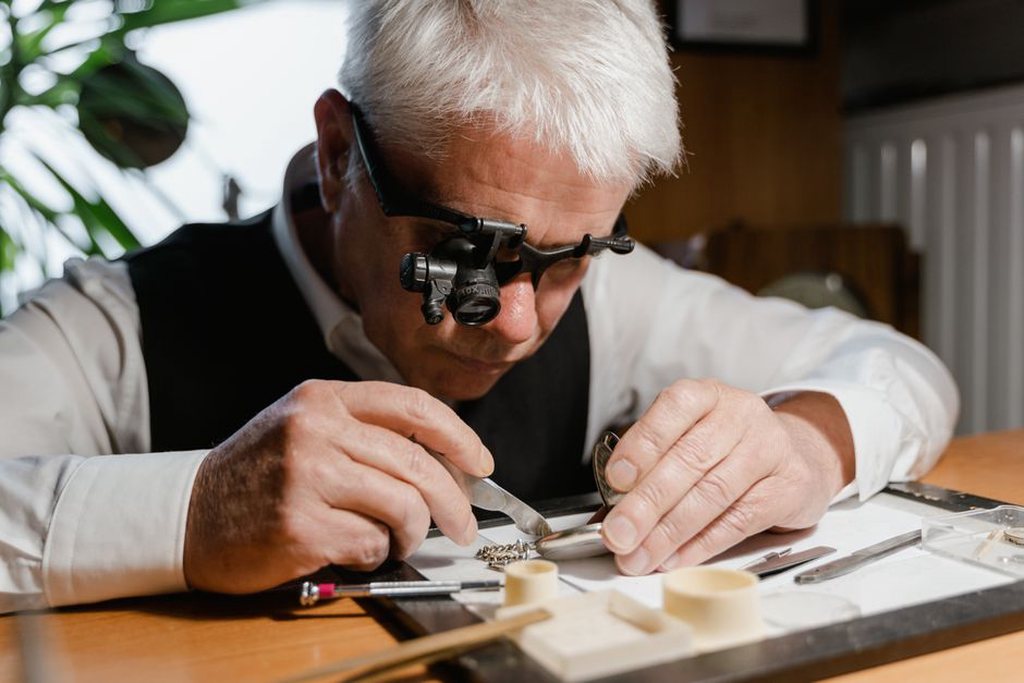
Hinged clips designed for thicker hair feature a roll-over clasp mechanism. On authentic pieces, the hinge pin is usually a separate piece of brass or steel, visibly inserted through a small tube. Modern replicas often cast the entire hinge as one piece with the clip body, eliminating the pin entirely. Examine the joint under a loupe: a genuine hinge will show a tiny circular end where the pin was cut and smoothed. A moulded fake hinge will lack this detail entirely.
French-made clips of the era, particularly those from workshops supplying Parisian couture houses, sometimes bear minuscule stamped marks on the metal findings—not hallmarks in the strict jewellery sense, but tiny maker's symbols like a diamond shape enclosing initials, or a simple "FRANCE" in sans-serif capitals. The font itself is a clue: authentic stamps use the slim, elongated letterforms characteristic of the period, while modern stamps tend toward bolder, more generic typefaces.
The Bakelite Question
Bakelite hair ornaments from the 1930s occupy a special category. True Bakelite is a phenolic resin that oxidises over time, developing a distinctive patina that shifts from the original colour. Cream Bakelite mellows to butterscotch; pale pink deepens to a dusty rose. This colour change is not surface-level but penetrates the material. A simple test involves rubbing the piece vigorously with a thumb until warm: authentic Bakelite releases a sharp, medicinal formaldehyde scent. Simichrome polish applied to a cotton bud will leave a yellow residue on genuine Bakelite but nothing on modern plastics. Replicas made from catalin or modern phenolic resins can mimic the look but rarely reproduce the precise patina gradient of a piece that has spent ninety years in a dressing-table drawer.
Stone Settings and the Art of Light
Rhinestone-adorned Deco hair clips rely on a specific setting language. The favoured technique was the "millegrain" edge—a delicate beaded border created by a knurling tool that pushed up tiny dots of metal around the stone. Under magnification, authentic millegrain work appears irregular and slightly soft, each bead individually formed. Modern casting often replicates the look but produces perfectly uniform beads that lack the hand-tooled character.
Stones themselves were typically foil-backed glass. The foil, usually silver or gold-toned, was applied to the pavilion to enhance brilliance. Over decades, this foil can develop a subtle crackled texture or a faint darkening at the edges. This aging is desirable and expected. A replica with artificially darkened foil often looks uniformly dull rather than possessing the varied, organic shadowing of genuine age. The stones in authentic Deco pieces are frequently set in geometric clusters—a central emerald-cut crystal surrounded by four smaller square stones, or a fan of tapered baguettes. The arrangement follows a mathematical precision.
Silhouettes That Defined an Era
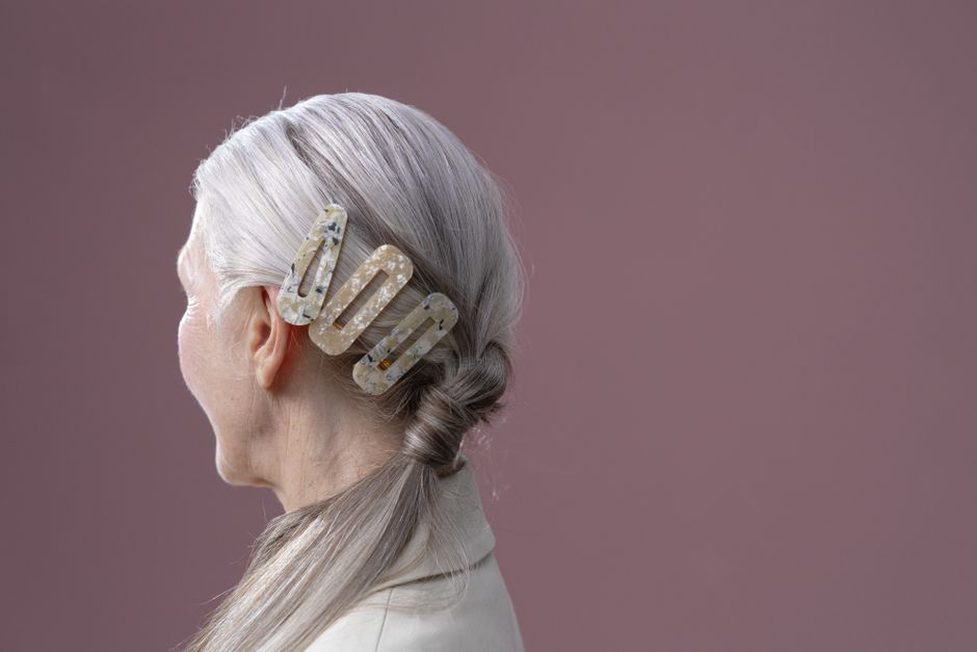
Several specific clip shapes recur with enough frequency to serve as reference points. The "Eton crop" barrette is a narrow, rectangular slide, often set with a single row of channel-set crystals, designed to lie flat against slicked-down hair. The "dress clip"—originally intended for furs and lapels—doubled as a hair ornament and typically features a double-pronged fur clip mechanism on the back. When you find a Deco dress clip repurposed for hair, the presence of those two sharp prongs alongside a hinged bar is a strong authenticity indicator; modern hair-specific replicas rarely include this dual mechanism.
The double-clip comb represents a hybrid form: two matching geometric clips connected by a fine chain or a rigid bar, designed to anchor a wave on either side of a deep side parting. Authentic chains on these pieces are often extremely fine, with links so small they resemble a continuous thread. Replica chains tend to be heavier and less flexible.
Developing an Educated Eye
No single detail confirms authenticity in isolation. It is the cumulative evidence—the slightly uneven millegrain, the warm patina on galalith, the visible hinge pin, the precise yet not machine-perfect symmetry—that builds confidence. Spend time handling confirmed authentic pieces at vintage fairs or museum collections where touch is permitted. Notice how a 1920s celluloid comb feels almost weightless compared to a modern resin copy. Observe the way light sinks into aged Bakelite rather than bouncing off its surface.
When considering a piece, ask practical questions about its construction logic. A genuine Deco hair clip was built to function in hair that was often fine and bobbed; its clasp will grip with intention. A purely decorative replica might prioritise appearance over wearability, with a clasp that feels loose or awkwardly balanced. The authentic object carries the memory of its original purpose, and that purpose is encoded in its engineering.
For those interested in the archival care of vintage hair ornaments, the principles of storing a delicate celluloid or galalith piece share much in common with preserving other mid-century accessories. Archival storage techniques for vintage hair clips apply equally to Deco treasures, particularly the avoidance of direct sunlight and extreme humidity, which can accelerate the deterioration of early plastics. Similarly, the refined restraint of Deco design finds a natural companion in other 1920s accessories. The velvet pearl headband of the 1920s shares the same aesthetic DNA—a marriage of sumptuous material with geometric precision—and often appeared alongside Deco hair clips in the evening ensembles of the Bright Young Things.