
Choosing Vintage Hair Scarf Fabrics: A Practical Guide
A scarf label can mislead. “Silk” may describe a fine, fluid square that slides off a smooth bob, while a 1940s rayon scarf can be weightier, warmer and much easier to manage in a turban knot. The better first test is not the decade stated in a listing, but how the fabric behaves in the hand: its weight, grip, opacity, crease recovery and response to a gentle knot.
Vintage hair scarves have had many roles in British wardrobes: covering a set hairstyle on the commute, serving as a modest head covering, bringing colour to a tailored coat, or keeping hair in place on a windy day at the seaside. The material shaped how well each scarf performed. Choosing carefully also protects fragile originals, because the loveliest piece is not always suited to daily wear.
Begin with the scarf’s intended shape
Decide how the scarf needs to sit before concentrating on fibre. A small square folded into a slim band needs crispness and enough friction to remain tied. A triangle worn beneath the chin benefits from drape and moderate opacity. A large wrap around a chignon needs body without too much bulk. The same 1950s floral print will behave very differently in silk twill, cotton voile or synthetic chiffon.
| Styling use | Most useful fabric qualities | Often suitable materials |
|---|---|---|
| Narrow headband or bow | Grip, light structure, easy knotting | Cotton, silk twill, rayon |
| Classic headscarf tied under the chin | Drape, opacity, manageable weight | Silk twill, rayon, fine cotton |
| Turban or wrapped crown | Body, resilience, low slipperiness | Cotton, rayon, lightweight wool blends |
| Loose decorative wrap over pinned hair | Fluidity, length, soft finish | Silk crepe, chiffon, rayon |
| Cold-weather scarf at the hairline | Warmth, softness, limited bulk | Wool, cashmere blend, silk-wool blend |
Size matters as much as fabric. A 50 cm square makes a compact, 1950s-inspired knot, but may be too short for a full turban. Squares of roughly 70–90 cm allow more variation. Long oblong scarves wrap neatly around a low bun or braid, although their proportions tend to suit a headband effect better than the familiar diagonal-folded headscarf.
Silk: refined, versatile and sometimes slippery
Silk is closely linked with twentieth-century scarf design because it takes saturated colour and fine printed detail so well. Yet “silk scarf” covers several distinct fabrics. Weave and finish often matter more in wear than fibre content alone.
Silk twill
Silk twill has fine diagonal ribs, often visible when it is held to the light. It is the familiar fabric of many printed square scarves: substantial enough to fold cleanly, yet soft enough not to look stiff. Its relatively matte surface offers more purchase than glossy silk satin, so it is one of the more practical choices for a knot at the nape or beneath the chin.
Even twill can shift on very smooth hair or a polished updo. Instead of pulling the knot tight enough to crease the fabric, lay the folded scarf over a small fabric-covered elastic, or fasten the ends discreetly to the hairstyle with two fine pins. Avoid pinning through an aged silk panel; where possible, work through folded layers near an edge.
Silk crepe, chiffon and satin
Crepe has a subtly pebbled surface and a soft, graceful fall. It suits loose wraps and fuller bows particularly well, though older crepe can be thin along its folds. Chiffon is light, transparent and airy; it gives a lovely layered effect but usually needs more careful anchoring. Satin is easy to recognise by its lustre and smooth face. It catches the light beautifully, but may slide, snag or show water marks more readily than twill.
Keep fragile silk satin and chiffon for occasions when they will not be repeatedly tightened, caught in rain or tucked under heavy outerwear. A modern silk scarf of a similar weight can take the place of an original in a regular rotation.

Cotton: dependable structure and everyday ease
Cotton is often the most forgiving material in a vintage scarf collection. It breathes, holds a knot and usually tolerates regular handling better than fine silk, although age and earlier laundering will affect its strength. A cotton square is useful for practical head coverings, bandana folds, high knotted bows and wraps around a ponytail or bun.
The finish makes a difference. Cotton voile is light and semi-sheer, with an airy drape. Lawn is smooth, finely woven and a little crisper. Poplin has more body, producing a tidy, graphic bow. Heavier printed cotton can look more casual, yet it is often ideal for a 1940s-style hair wrap because it is less likely to loosen throughout the day.
Examine old cotton for fading along the centre fold, brown storage marks, weakened edges and small pinholes. These flaws do not automatically rule out wearing it, but they should influence the styling. Hide a faded area within a fold and avoid drawing a knot tightly across a brittle patch. If a scarf has a sentimental print but widespread weakness, it may be better displayed in a shallow frame or used as drawer lining than worn further.
Rayon and viscose: period character with a little caution
Rayon, more commonly called viscose in Britain, appeared widely in mid-century accessories. It could imitate silk’s sheen or wool’s softness at a more accessible price, and surviving examples often feature floral, novelty or geometric prints. Its drape is excellent for scarf styling: it makes rounded knots and falls well from a turban or low ponytail.
Its chief limitation is its vulnerability when wet. Older rayon may shrink, distort, lose dye or become much weaker with moisture. Handle an untested vintage rayon scarf with dry hands, and do not assume a care label reflects its current condition. Dry cleaning is not automatically safe either. For a valuable or delicate piece, seek advice from a conservator or cleaner experienced with historic textiles.
Rayon benefits from a gentler tying method. Fold it broadly rather than drawing it into a narrow cord, then use a flat knot or tuck the ends beneath a fold. This limits strain and retains the scarf’s soft, period-appropriate line.
Wool and silk-wool blends: warmth without the bulky wrap
Fine wool scarves have a quiet place in vintage dressing, especially with autumn coats, knitwear and practical country-inspired outfits. Lightweight wool holds a sculptural bow or wrapped crown more readily than smooth silk, while silk-wool blends offer warmth with a finer fall. Their surface generally grips hair better, which is useful in breezy weather.
Check for moth damage before buying or wearing one. Tiny irregular holes, powdery debris, bare patches and broken fibres can point to past insect activity. Keep a suspected item away from other textiles until it has been assessed and cleaned appropriately. Perfume, cedar blocks and a quick airing will not deal with an active infestation.
Wool does not require frequent washing. After a short wear, air it away from direct sun and steam, then store it clean, dry and folded. Use acid-free tissue for particularly fine pieces. Hanging can pull a bias-cut or loosely woven scarf out of shape over time.
Synthetics: identify the weave, not just the era
Nylon, polyester and acetate became familiar in post-war accessories. They can be historically interesting in their own right, especially with bold 1960s and 1970s prints. Their wearability varies. Polyester crepe may resist wrinkles and retain colour well, while a shiny acetate scarf can crease sharply and become weaker with age, heat or perspiration.
Synthetic chiffon is often tougher than silk chiffon, though it can be prone to static and slipping. Texture helps: crinkle, crepe or woven jacquard makes a scarf easier to control. Very thin synthetic scarves may have heat-sealed edges, which should not be pressed hard or held near a hairdryer, radiator or styling tool.
Inspect vintage synthetics closely, as deterioration is not always visible at first glance. A tacky surface, cracking, stiffness, a strong vinegar-like smell in some acetate pieces, or fibres that snap when an edge is gently flexed are all signs that the scarf should not be worn under tension.
How to assess a vintage scarf before committing to it
Condition and fibre need to be judged together. A strong cotton scarf with a repaired hem may be a better everyday choice than silk that appears pristine but is beginning to shatter. At a fair, auction viewing or charity shop, ask permission to inspect the scarf in daylight and follow a simple routine.
- Hold it up to the light. Look for thinning at folds, pinholes, uneven density and repairs.
- Inspect the edges. Hand-rolled silk hems, machine stitching and hand-sewn repairs can all be appropriate. Judge their neatness and strength rather than treating one finish as proof of age.
- Check the reverse. Print clarity on both sides, weave irregularities and a modest maker’s label can offer clues, but labels alone do not authenticate an item.
- Feel for stiffness or stickiness. These can indicate old finishes, soil, adhesive residue or fibre degradation.
- Test the intended fold gently. Do not stretch or pull. If the fabric resists a simple diagonal fold or crackles at the crease, choose another way to wear it.
For a scarf described as designer, compare its construction, typography, print quality and provenance against reliable reference material. A familiar name, copied motif or logo-like label is not enough to establish authenticity. It can still be a charming vintage accessory without an uncertain luxury attribution.
Pair fabric with the rest of the outfit
Fabric can make a historically inspired outfit feel considered rather than theatrical. Matte cotton or silk twill works especially well with denim, a trench coat and a simple knit. Crepe or rayon softens a slip skirt, tailored trousers or a cardigan. A fine wool square can pick up the texture of tweed without turning the whole outfit into period dress.
Scale matters too. Small, dense prints suit narrow folds and compact knots, while large painterly motifs need more visible surface. If a scarf’s border is its strongest feature, arrange the fold so it frames the face or runs along the top of a headband instead of disappearing into the knot.
Texture can create an appealing contrast between accessories. A polished plastic barrette or comb is particularly striking against matte cotton or textured crepe. For a coordinated mid-century material study, pair a satin scarf carefully with a padded band; the construction and care considerations of a satin padded headband are useful context when combining glossy fabrics at the crown.
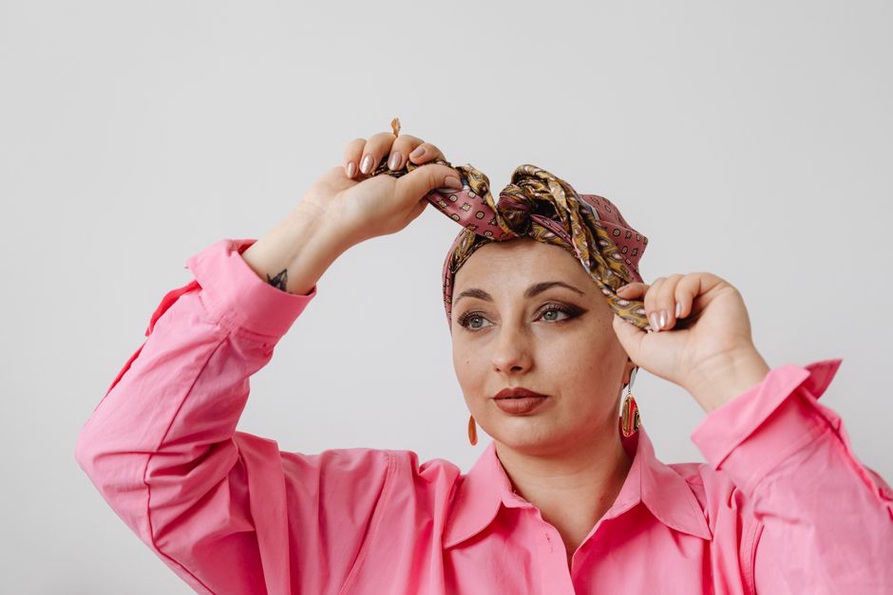
Cleaning, storage and low-strain wearing
Do not wash a vintage scarf simply because it is newly acquired. Identify the fibre where possible, check whether the colours appear unstable, and weigh its age, value and condition. Light dusting, careful airing away from sunlight and a spot assessment by a textile specialist are often safer first steps than a full clean. Home washing is most appropriate for sturdy, colourfast cotton with no particular fragility; even then, use cool water, minimal agitation and flat drying away from heat.
Store scarves clean and completely dry. Follow existing fold lines only if they are not already weakened; otherwise make broad, loose folds with acid-free tissue between layers. Keep silk out of direct light, avoid plastic bags that may trap moisture, and do not leave a scarf tied around a hanger or hair accessory between wears.
For a fragile 1950s silk square, make one broad diagonal fold and lay the centre over the crown. Cross the ends once at the nape, then secure each beneath the opposite folded edge with a small pin. The scarf remains visible, pressure is distributed across a wider area, and no tight knot has to carry the strain.