
Vintage Lace Hair Veils: How to Choose, Wear and Care for One
A small lace veil can look substantial on a table, then almost weightless when worn. Much depends on its edge: a narrow scallop softens the line across the forehead, while a deeper border draws the eye around the face. Hold a vintage veil up to the light before choosing it. Its pattern, transparency and the condition of its fine threads tell you more about how it might wear than a photograph taken with it laid flat.
What counts as a hair veil?
Hair veils include short pieces attached to hats or combs, as well as longer lace panels pinned over the back of the head. A face-covering veil is often called a blusher; a short net veil falling around the eyes or nose is commonly called a birdcage veil. Birdcage veils are usually made from open-mesh veiling rather than lace. Sellers may use these terms loosely, so look at the fabric and cut rather than the label alone.
A lace mantilla is a different form: traditionally a larger, often scalloped piece draped over the head and shoulders, with roots in Spanish dress and religious practice. An old mantilla should not automatically be treated as a spare bridal accessory. Its size, provenance and any evidence of devotional use warrant attention. In British vintage fashion, smaller lace fragments and hat veils may be easier to wear day to day, though their original purpose is not always clear.

A changing silhouette, not a single vintage look
In the late nineteenth and early twentieth centuries, veiling could be part of a hat’s construction, falling over the face or gathering at the back. Lace made the pattern prominent; plain or spotted net left more of the hat and face visible. Fabric alone rarely gives a secure date. Someone may have taken a veil off one hat and sewn it to another decades later.
By the mid-twentieth century, short veils were closely associated with structured hats and small headpieces. On some 1940s and 1950s examples, the veil curves gently away from the face instead of hanging straight down; a velvet trim, artificial flower or small bow may hide where it gathers. A minimal face veil might accompany a neat pillbox or other compact hat in the 1960s. These shapes do not belong exclusively to particular decades: alterations, revivals and later reproductions muddy the timeline.
Colour can mislead, too. Black lace is not necessarily mourning wear, nor ivory lace necessarily bridal. Before assigning an occasion, consider the mounting, length, decoration and any documented history of the whole piece.
Reading the lace and its attachment
Fabric and workmanship
In lace, the threads form the pattern; it is not simply a motif printed onto mesh. Vintage veils may use machine-made or hand-worked lace, embroidered tulle, or net edged with lace. Machine-made does not mean lesser: it made intricate-looking accessories accessible beyond the most expensive wardrobes. Notice how the motif meets the border. A tidy scallop can frame the face, but an unravelling cut edge calls for especially gentle handling.
Examine a prospective purchase in good daylight against a plain background. Look for tiny breaks where pins have repeatedly passed through, discolouration along an old fold, or stiff patches that might point to glue or an unsuccessful repair. Slightly uneven colour may simply show age; brittle threads affect whether the veil can be worn. If lifting an edge produces a faint crackle or makes threads separate, keep the piece for study rather than wear.
How it stays in place
Some veils still have their original comb, clip or hat fitting; others survive as loose lengths. Check the stitching where the fabric attaches, since that point takes the strain. New thread on old lace may be a sensible repair, but a seller should describe it honestly. Likewise, an apparently antique veil on a modern plastic comb may be an adapted vintage textile, not an untouched period accessory.
If you are buying at a distance, ask to see the reverse, the fastening and the whole veil spread against a contrasting surface. Get the drop measured from the attachment to the lowest edge, as well as the width at its widest point. Ten centimetres can be the difference between lace sitting above the eyes and catching against the mouth.
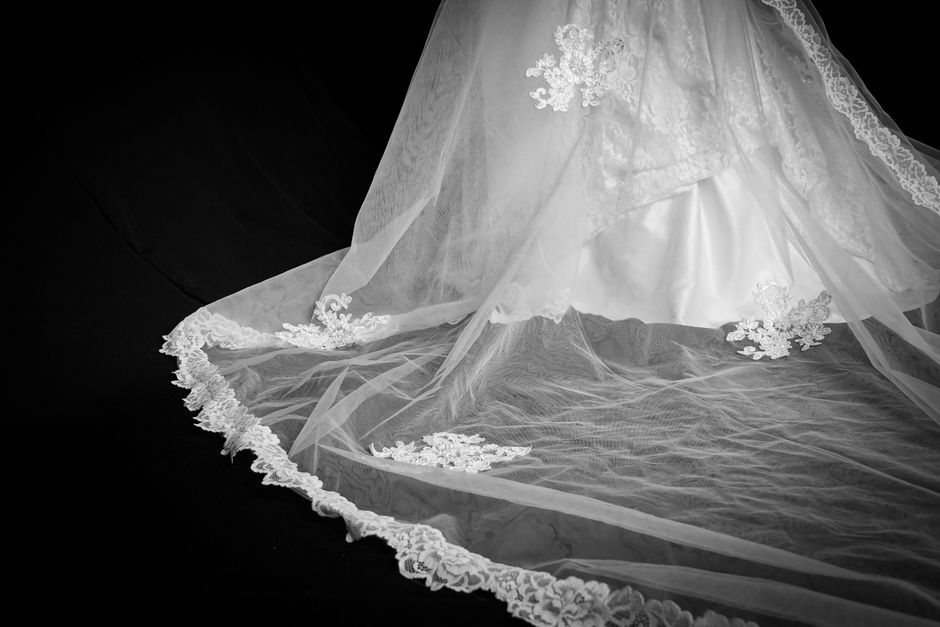
Wearing lace without turning it into costume
Give the veil one clear role. Against a simple dark dress or a well-cut jacket, short black lace can be a patterned accent rather than a historical quotation. Ivory or ecru need not suggest bridalwear alongside modern suiting, particularly if the edge sits behind the hairline instead of covering the face. Texture matters more than an exact colour match: matte lace against crisp cotton or wool has a different effect from lace layered over more lace.
- For a face veil: check the drop while standing and walking, not just in a mirror. The lower edge should not brush your lips or obscure the route ahead.
- For a comb-mounted veil: place the comb in a secure section of hair and let the fabric hang freely. Do not pull the lace taut to make it symmetrical.
- For a loose panel: put discreet, smooth pins through a sturdy edge or existing mounting stitches, never through a delicate motif just to force a new shape.
There is room for another small accessory if both pieces sit comfortably. A plain velvet clip, for instance, can anchor an arrangement without competing with patterned lace; the history and care of a vintage Petit velvet hair clip offer a useful comparison in texture and fastening. Keep heavy brooches away from unsupported net. Their weight can turn a pinhole into a tear.
Care that respects fragile threads
Handle an older veil with clean, dry hands, supporting the whole piece as you lift it. A soft brush may be enough to remove dust. Do not assume yellowed lace can safely be washed white: water, detergent and agitation may distort net, release dye from trim or weaken an old repair. If cleaning is essential before use, consult a textile conservator rather than experimenting on a rare or fragile piece.
Store the veil flat if you can, with acid-free tissue underneath and between any folds. If folding is unavoidable, pad broad folds softly rather than pressing sharp creases into the lace. Keep metal fittings off the fabric, especially if they show corrosion, and leave enough space in the box that hooks cannot catch neighbouring textiles. Put a note of any known history outside the wrapping, not pinned to the veil.
Before wearing a newly acquired veil, lay it flat for a few hours and check the attachment stitches again. If one side hangs lower, move the comb first. Tugging at the lace to level the scallops puts strain on the very edge you want to preserve.