
Wearing Vintage Lapis Lazuli Lion Earrings as Hair Accessories
Lions have appeared in jewellery for centuries, but lapis lazuli gives the motif a contemplative edge. The deep midnight blue, flecked with golden pyrite, softens the beast's ferocity into something more meditative. This tension — between the lion's fierce symbolism and the serene depth of lapis — makes vintage lion earrings so compelling, and unexpectedly useful as hair ornaments.

The Legacy of Lapis Lazuli
Lapis lazuli has been prized since antiquity, traded along the Silk Road from the remote mines of Badakhshan in present-day Afghanistan. In Medieval and Renaissance Europe, the stone was ground into ultramarine pigment for illuminated manuscripts and altarpieces. By the Victorian era, lapis had become a favourite for cameos, intaglio seals and, later, Art Deco dress clips. Its colour symbolism — associated with royalty, wisdom and truth — made it a natural choice for heraldic and mythological subjects. A lion carved from lapis carries not only the weight of the beast's traditional guardianship but also the stone's long history of spiritual protection.
The Lion Motif in British Jewellery
The lion appears in British jewellery with remarkable consistency. In the late 19th century, lion's head bracelets and brooches were common, often executed in gold or silver with gemstone eyes. The 1920s and 1930s saw a particular vogue for lion head earrings — usually clip-ons — rendered in carved hardstones such as onyx, jade and lapis lazuli. These were not miniatures of a roaring mane; instead, they stylised the feline profile into sleek, geometric shapes that complemented the bobbed hairstyles and streamlined silouettes of the era. The lapis examples are among the most sought-after because the stone's even colour allows for clean, crisp carving, and the golden inclusions catch the light when the earrings move.
Transforming Earrings into Hair Accessories
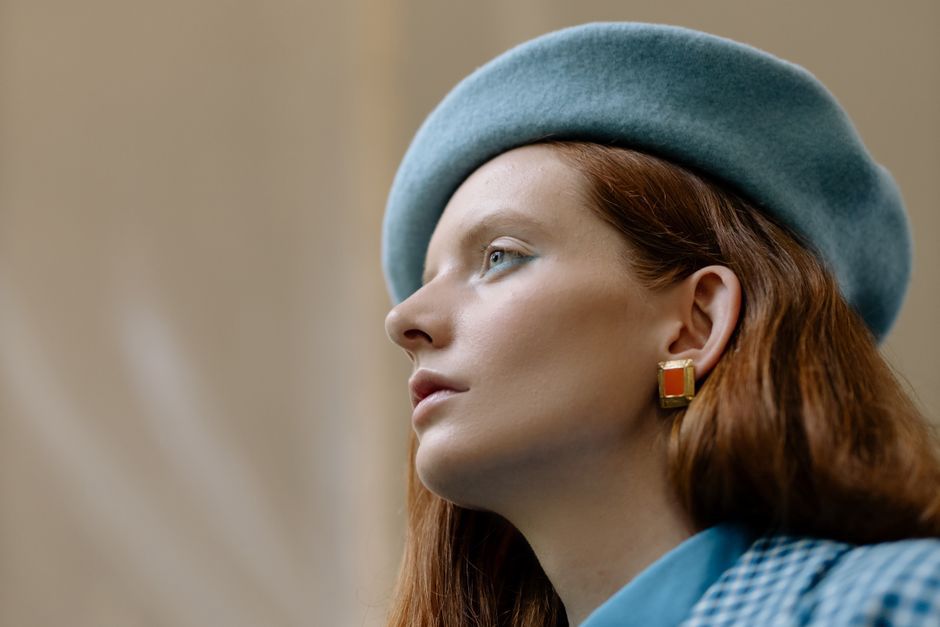
Not every vintage earring was destined to stay on the earlobe. Clip-on mechanisms, common from the 1910s through the mid-20th century, lend themselves beautifully to being worn in the hair. The tension of the spring clip grips a lock of hair or a small section of a chignon just as securely as it would an earlobe. For those with fine or slippery hair, a small velvet-covered hair elastic or a fabric-wrapped bobby pin can be threaded through the clip to add friction. The result is a one-of-a-kind ornament that instantly lifts a simple ponytail, a low bun or even a half-up style.
Lapis lazuli lion earrings work especially well because the motif is both bold and refined. Placed at the temple, they echo the decorative combs and banquets of the 1920s; nestled at the nape of the neck, they recall the sculptural hair jewells of the Belle Époque. Because the stone is not overly glossy, it pairs beautifully with textured modern fabrics — think a nubby wool coat, a linen dress or a cashmere jumper. The gold or silver backing of the earring adds a warm metallic accent that can be echoed with a simple chain necklace or a pair of stids in the same metal.
Practical Tips for Wearing Clip-On Earrings in Your Hair
- Test the grip. Before wering out, clip the earring onto a small section of hair at home and gently shake your head. If it slips, add a tiny piece of silione grip pad (available from jewellery supply shops) to the inside of the clip.
- Protect the stone. Lapis is relatively soft — 5.5 on the Mohs scale — so avoid placing it where it will rub against metal hair clips or harsh elastic bands. Let the earring sit on top of the hairstyle rather than being woven through it.
- Match the scale. Lion earrings from the 1930s are usually about 1.5 to 2.5 cm in diameter. This size is ideal for a side-swept curl or as a focal point on a low bun. Larger versions from the 1950s can anchor a full updo.
- Use a companion hairpin. For extra security, slide a U-shaped hairpin through the earring's clip loop (if present) and into the hairstyle. This prevents the earring from twisting or falling off.
Care and Handling of Your Lapis Lazuli Treasure
Lapis lazuli is porous and sensitive to moisture, heat and harsh chemicals. Never clean it in an ultrasonic cleaner or with abrasive polishes. Instead, wipe the stone gently with a soft, dry cloth after each wear. If the metal backing needs cleaning, use a slightly damp cotton bud and dry immediately. Store the earrings separately in a soft pouch — not jumbled with other jewellery — to avoid scratches. Direct sunlight can fade the deep blue over time, so keep them in a drawer or a lined box away from windows.
When you inherit or acquire a pair of vintage lapis lion earrings, check the clip mechanism for wear. The spring may have weakened after decades, but a good jeweller can often replace it without damaging the stone or the setting. Similarly, if the lion carving has dulled, a very light buffing with a jeweller's cloth (designed for silver and gold only, not for the stone itself) can revive the lustre of the metal surround.
For those who enjoy the thrill of the hunt, lapis lion earrings appear regularly at British antique fairs, particularly those specialising in 1920s and 1930s jewellery. Look for pieces where the carving is detailed — the eye, the muzzle, the curve of the mane — rather than a generic blob. The best examples use the natural grain of the lapis to suggest the animal's musculature. A similar repurposing philosophy can be found in our guide to tagua chandelier earrings, where we explore how statement earrings become hair jewels.
Wearing a piece of history in your hair is a quiet act of preservation. Each time you clip that small blue lion into a twist or a braid, you are continuing a craft tradition that began in a Afghan lapis mine, passed through a British workshop, and finally rests — for a few hours — against your own carefully curled hair. The effect is neither costume nor imitation; it is the real thing, worn on your own terms.
If you happen upon a pair of these blue lions at a car boot sale or a dusty shop near Camden Passage, take a closer look. With a little care and a clever hairpin, they might just become your most asked-about accessory.