
The Red Rose Crown Headband: A Collector’s Guide
Not all red roses are equal. When British collectors talk about a vintage red rose crown headband, they are not reaching for a generic Valentine’s bloom. The shade matters: think of the deep, slightly blue-tinged crimson of a Rosa gallica officinalis, or the velvety oxblood of a late-season ‘Tuscany Superb’. A true vintage red rose crown headband never shouts – it holds its colour with the quiet confidence of a fabric dyed with cochineal or alizarin, set against dark velvet or aged tortoiseshell. That precise, non-fluorescent red is what separates a collectible piece from a mass-market modern copy.
The Origins of the Rose Crown in British Hair Fashion
The rose crown — a circlet of fabric or silk flowers worn across the crown of the head — first became a real presence in the Edwardian era. As women moved away from heavy hats to simpler hairstyles, they started pinning ornaments directly into their hair. The red rose was already an English emblem, from the Tudor rose to the Lancashire rose, so it made sense. It also turned up constantly on postcards, souvenir china and needlework, which made it feel familiar rather than formal.
By the 1910s, milliners were making headbands with clusters of handmade silk roses, wired and mounted on velvet-covered bands. The true crown style — roses sitting on top of the head rather than on a forehead band — emerged in the 1920s. Women with bobbed hair liked the sculptural accent because it did not get in the way of the new short cuts.
Materials and Construction: What Makes a Vintage Red Rose Crown
Genuine vintage pieces depend on construction methods you rarely see now. The petals are not cut from a single sheet. They are shaped one by one with heated tools that cup and curl silk or rayon satin, and each rose is assembled by hand with a centre of stamens — often tiny glass beads or yellow thread — and a green velvet or tulle calyx.
The band is usually stiff buckram or millinery wire covered in silk or velvet. Roses are attached with fine brass wire, never glue; glue yellows and rots silk over decades. If you see a plastic stem or a trace of hot glue, it is not vintage. Colourfastness is another clue: vintage red roses may fade to rusty pink or deepen to brownish maroon, but they should not bleed onto the band when touched with a damp cloth. That points to proper pre-1960s dyeing.
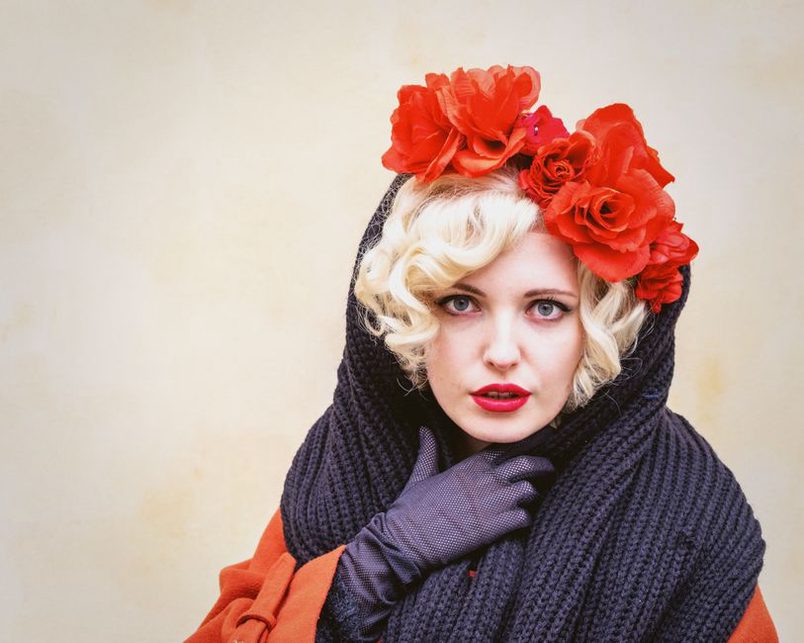
The Red Rose Crown in Mid-Century British Culture
The 1950s and 1960s were the red rose crown’s heyday in Britain. Post-war brides often wore a smaller version instead of a tiara, and debutantes at Queen Charlotte’s Birthday Ball chose red roses against white gowns. In 1962, a widely printed photograph of Princess Margaret wearing a deep crimson rose crown at a garden party made the old ornament look fresh. The queen’s sister had that effect.
Later in the decade, the mod crowd adopted the crown, but changed it. Their roses were smaller, the headband thinner, and the whole piece sat low on the forehead rather than across the top of the head. You will most often see two silhouettes from this period: the ‘full crown’ (three to five large roses across the top) and the ‘side spray’ (a cluster of two or three roses set asymmetrically near the ear). The full crown was the one chosen for weddings and formal dances; the side spray was easier to wear with a hat. Both are collectible; the side spray is scarcer.
Identifying a Genuine Mid-Century Piece
At an antiques fair or online, turn the piece over before you commit. Authentic 1940s–1960s crowns have a hand-sewn satin backing, usually in a contrasting shade such as pale pink or ivory. Each rose is wired separately, so you should be able to nudge one without disturbing the rest. The band is about 1.5 to 2 cm wide, with a metal core that can be gently bent to fit your head. The best pieces often came from small London millinery workrooms and from the Edinburgh-based firm Muriel Hill; if there is a faint maker’s mark on the inside of the band, even better.
Styling the Red Rose Crown with a Modern Wardrobe
The red rose crown headband works outside period costume better than you might expect. Treat it as a single statement and let it be the only prominent accessory. With a plain white or cream blouse and dark slim trousers, it reads as 1950s without tipping into fancy dress. At a summer garden party, a floral maxi dress with a small-scale print gives the roses a colour echo; pick out the red in the pattern. For evening, a black velvet dress is the fastest way to make the crown feel dramatic rather than costume-like.
For a quieter look, wear it with a charcoal or navy cashmere roll-neck. The soft wool against glossy silk petals gives the headband a different kind of presence — casual, but not careless. If you like wearing two narrow headbands at once, skip a second ornamented band. Let the rose crown sit alone, a few centimetres behind the hairline.
A useful companion is The Ina Velvet Twist Headband: A Vintage British Hair Accessory Guide, which discusses balancing proportion and colour. The same restraint applies: if the rose crown is large, keep earrings small and hair simple.
Caring for a Delicate Red Rose Crown
The silk and rayon petals are fragile, so handle the crown gently. Keep it out of direct sunlight: vintage red dyes are sensitive to UV and fade unevenly. Wrap the band in acid-free tissue paper, box it, and never hang it — the weight of the roses can stretch the wire. If the band is bent out of shape, ease it back with your hands while it is off your head.
For dust, use a soft, dry paintbrush, size 4 or 6, and sweep lightly between the petals. If a petal gets crushed, do not iron. Hold a steam iron at a distance and let the steam relax the fabric, then reshape the petal with your fingers. Keep water away from the whole piece, because moisture stains velvet and rusts the wires. If the band really needs cleaning, touch the velvet with a barely damp cotton bud and blot immediately with a dry cloth.
Where to Find and What to Pay
Red rose crowns are rarer than ivory or pastel versions, because red was a statement colour and fewer were made. In the UK, your best chances are specialist vintage hair accessory dealers, including those at the Vintage Fashion Fair at Olympia in London, or collectors’ communities online. A good-condition piece — all roses intact, minimal fading, no rust on the wire — typically goes for £50 to £150. Exceptional examples with a maker’s mark or provenance can fetch £200 or more. As a rule of thumb, you are paying for the rose work, not the band; a simple band with exceptional roses is worth more than a pretty band with flattened flowers.
Rather than chasing a bargain, buy one example that fits your head size and suits the rose cluster shape you prefer. With proper care it will last for decades, and the colour becomes more interesting as it ages — a subtle patina you cannot fake.
When you find the right one, try it with a side-parted chignon or a loose low bun. The red roses will catch the light differently from every angle — that is the reward of hand-worked petals, wired with patience and still blooming after sixty years.