
Vintage Pearl Hair Combs and Pins: How to Spot, Wear and Care for Them
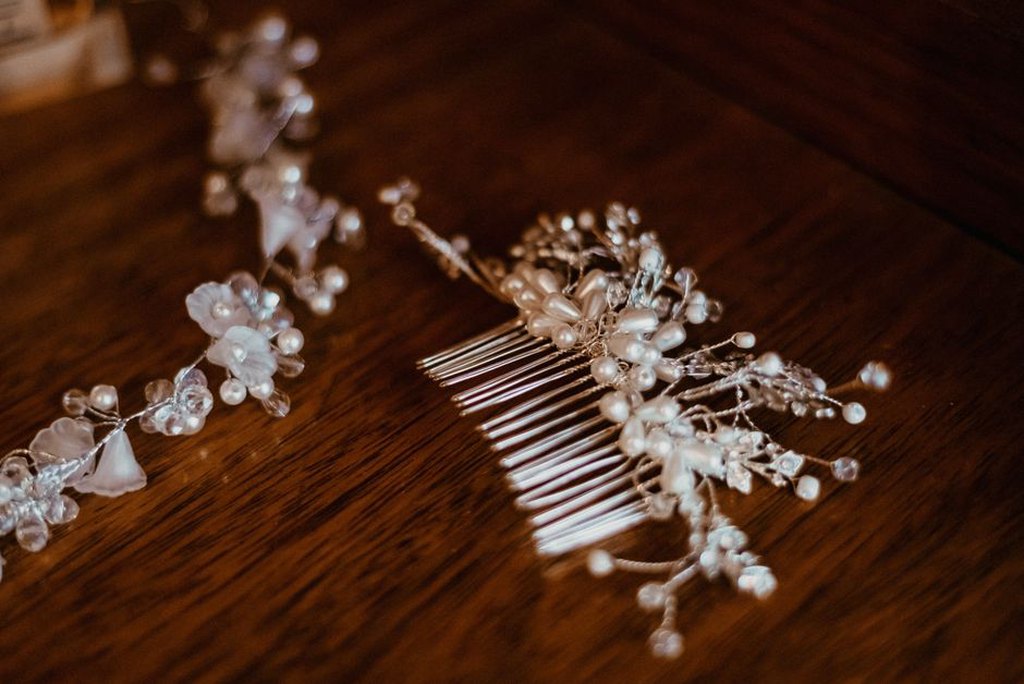
A pearl that looks embedded in a vintage hair comb may be sitting on a tiny metal peg. Turn the comb over and you might find a different sort of fitting altogether: wire threaded through drilled beads, stitches that disappear into velvet, or a shallow cup holding an undrilled imitation pearl. Those fittings often tell you more than the sheen. They help you judge whether a comb is ready to wear or ought to stay in its box until a loose bead has been secured.
A small light in the hair
Where faceted stones flash, pearls catch the light in a soft highlight that shifts as you turn your head. A row of pearls follows the curve of a comb’s crest; spaced out on individual pins, they seem to float. Seed pearls, as particularly small pearls are called, can pick out the veins of a leaf or the edge of a petal without hiding the metalwork beneath.
In British evening dress around the turn of the twentieth century, pearl-set tiaras and combs rose above the hair, where their outlines could be seen. Some tiaras could be detached from their frames and worn as necklaces. A pearl-tipped pin does something quieter: it marks a single point on a twist rather than crowning it. In mid-century bridal wear, makers could stitch imitation pearls along the scalloped edge of a fabric headpiece. Hollow beads or lightweight plastic gave that outline without the weight of solid glass.
These shapes come back into fashion often enough that looks alone are a poor guide to age. A floral spray of ivory-coloured beads might be a period piece, a later bridal ornament or a recent revival. Ask for a photograph of the fitting and any maker’s mark. A seller’s description of ‘Edwardian style’ may tell you how the piece looks, not when it was made.
Read the bead and its fitting together
Natural, cultured or imitation
Natural and cultured pearls both form inside molluscs. The difference is that people initiate the process for cultured pearls. Imitations are made to look like pearls, often with a lustrous coating over glass or plastic. In older listings, ‘pearl’ may refer only to the colour or finish, while ‘seed pearl’ is sometimes used loosely for any tiny pearl-like bead.
Examine the beads in diffuse daylight, paying particular attention to drill holes and the spots where each bead meets its mount. A lifting flake that reveals a smooth core of a different colour strongly suggests a coated imitation. Small irregularities and variations in lustre are clues, not proof that a pearl is natural or cultured. Perfect roundness doesn’t prove it’s an imitation, either. Skip the tooth and scratch tests: they can damage the finish and won’t reliably tell you whether a genuine pearl is natural or cultured. If the price hinges on that distinction, ask for a gemmological report that identifies the pearls in the piece.
Where vintage pieces tend to fail
- Wired beads: Check where the wire meets the frame for a flattened kink or a broken strand. If a spray droops, the wire may be weak rather than simply bent. Don’t assume it can be straightened.
- Stitched ornaments: On a velvet bow or fabric-covered clip, look for loose loops, splits in the backing and beads pulling away from the cloth. A single broken thread can loosen several beads if they’re sewn along the same run of stitching.
- Peg and cup settings: A half-drilled bead may fit over a peg, while an undrilled bead may be glued into a shallow cup. A gap under a bead, a bare peg or excess glue around one setting can point to damage or an earlier repair.
A replacement bead needn’t put you off wearing a piece. Compare its colour and height with the neighbouring beads, then check the underside for rough edges. A slightly brighter bead is mostly a matter of taste. A wire end that snags a scrap of fine cloth is likely to catch in your hair, too.
Wear the ornament where its weight can rest
A wide comb topped with glass beads can feel surprisingly top-heavy. Instead of pushing it into loose hair, place it at the edge of a secured twist or bun and slide the teeth into the section that’s already anchored. If the comb tilts, try sitting it lower against the bun before reaching for more pins. A small pearl clip can sit just above one ear. Check that the clasp closes cleanly over the section of hair you want it to hold.
If you’d rather the pearls didn’t look bridal, try a smaller piece. A single low clip worn with a dark wool jumper gives a little glint without competing with the neckline. Two small pins close together on one side of a low knot look like one ornament; space them evenly on either side and the effect feels more formal. On a velvet bow, a few beads at the knot leave the folds and the pile of the velvet in view.
After wearing: clean the surface, not the whole piece
Put the ornament in after using hairspray or perfume. Take it out before undoing your hair, holding the comb or clip itself rather than the beadwork. Gently wipe the pearl surfaces you can reach with a soft, dry, lint-free cloth. Avoid soaking, jewellery dips and ultrasonic cleaning. Old adhesive, delicate coatings, metal and cloth can sit within millimetres of one another on the same piece.
Store a comb with a raised spray in a shallow box whose lid clears the highest bead. Use a smooth lining and rest the comb so its teeth are supported without pressing on the spray. If the comb slides when you move the box, tuck a small roll of acid-free tissue beside its spine. Keep the tissue out from between the wires, where it can snag.