
1920s Beaded Hair Clips: How to Recognise, Wear and Care for Them
A row of tiny glass beads can change the character of a plain metal hair clip. On a 1920s example, they might form a stepped border, a small flower or a flash of colour beside a wave of hair. It is a modest ornament, made to catch the light when its wearer moves.
Beaded clips belonged to a broader range of 1920s hair adornments, alongside combs, bands, pins and elaborate evening pieces. They brought together a practical fastening worn close to the head and beadwork familiar from dressmaking, millinery and jewellery. There is more to them than a shorthand for the flapper look.
What counts as a 1920s beaded hair clip?
‘Clip’ is a useful modern description, though it may not be the name under which a piece was sold. Surviving accessories have hinged clasps, spring mechanisms or decorated elements attached to simple metal grips. Sellers use barrette, slide and hair ornament inconsistently, too. Look at the fastening as closely as the decoration: it helps explain how the piece sat in the hair and whether it was meant to hold a section in place or chiefly embellish it.
Some beadwork was stitched to fabric or mesh and secured to a fitting. Other pieces set beads against stamped metal or paired them with imitation pearls, paste stones or enamel. An old beaded motif on a replacement clip may contain period beadwork, but it is not an intact 1920s clip. The distinction matters when a listing says only ‘Art Deco’.
Why the decade gave small ornaments a new role
Haircut, placement and movement
The bob became an emblem of the 1920s, though women wore many lengths and arrangements throughout the decade. Short cuts and hair dressed close to the head offered a different setting for decoration than the large Edwardian coiffure. A small ornament could mark a side parting, sit near the temple or punctuate a smooth wave without getting lost in a mass of hair. On longer hair pinned up to resemble a bob, a clip could help define the outline.
A decorated clip did not necessarily provide a firm hold. Its weight and the strength of an old clasp both matter; some pieces work better as accents over an already secure style. That small scale is part of their appeal. A glint near the face could be effective without the height of a comb or the breadth of a headband.
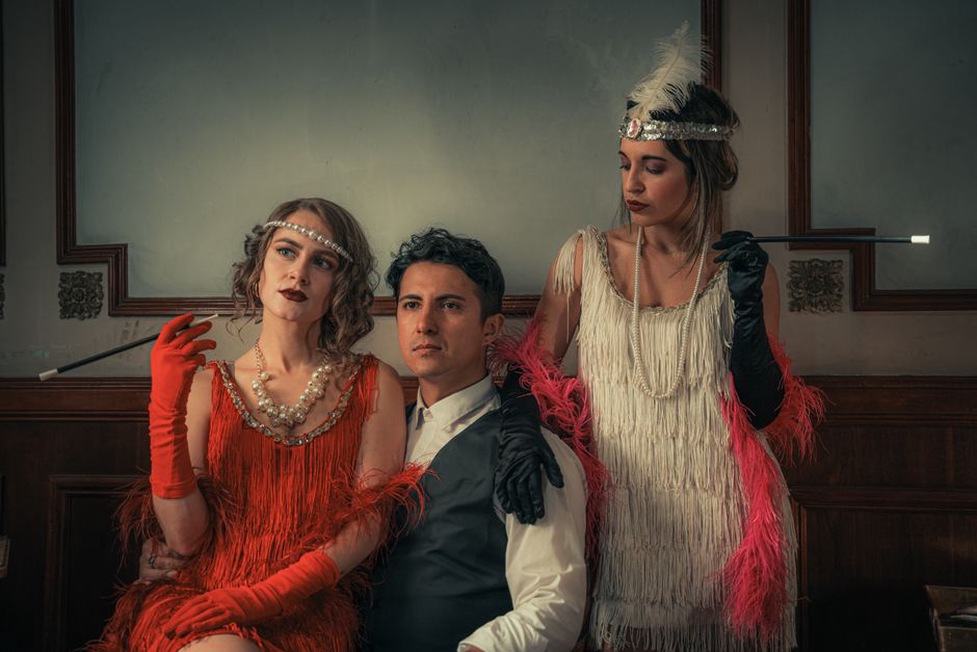
Beadwork beyond the dress
Beads bring 1920s evening dresses to mind, but there was no rule that hair ornaments had to match them. A beaded clip might echo a dress’s surface, contrast with a plain outfit or provide the ensemble’s only shimmer. Glass beads came in varied colours, finishes and sizes. Set close together, even inexpensive ones could look rich under artificial light.
The decade also drew on older skills and materials. Seed-bead embroidery, metal findings and imitation gemstones did not appear overnight in 1920. Often it was the arrangement that changed: a compact shape, a sharp outline or a motif suited to flatter hairstyles. Calling every geometric beaded ornament ‘Art Deco’ misses that continuity. Some designs used fashionable angular lines; others kept floral forms or conventional symmetry.
How beadwork produced the look
Look past the silhouette and the maker’s choices become easier to see. Small beads might be sewn in parallel rows for a crisp edge, clustered to build raised texture or placed around a larger central bead. A contrasting outline makes a motif legible at a glance. Uneven spacing, though, does not prove age or handwork. Beads vary, repairs alter patterns, and later makers can imitate older techniques.
Glass was a common decorative choice, in both opaque and translucent finishes. Imitation pearls could soften a design; metallic-looking beads added brightness without precious metal. Underneath might be textile, mesh or a shaped backing. On stitched work, the reverse may show thread paths, knots and strain. On wired or mounted pieces, check how securely the decoration meets the fitting. Materials alone rarely establish a precise date.
Nor was the 1920s palette confined to black and silver. Pale beads, jewel tones and dark contrasting outlines could all create period-appropriate effects. Surviving colours may have shifted: coatings wear, metal tarnishes and fabric grounds discolour. A muted clip may once have looked much brighter.
Reading a surviving piece without forcing a date
A clip can carry several histories at once. Its beaded panel, clasp and connecting thread may not be the same age. Start with the whole object rather than taking one fashionable motif as proof of origin.
- Check the construction. Is the beadwork part of the backing, or does it seem to have been transferred from another object? Look for extra stitch holes, fresh adhesive or a panel that does not fit its mount.
- Examine the fastening. Open and close it gently. A clasp that looks newer than the ornament may be a practical repair, not proof that the beadwork is modern.
- Look for wear in plausible places. Friction near the hinge and along the back can be informative, but artificial ageing and decades in storage make wear an unreliable clock on its own.
- Assess missing beads and loose threads. A gap in a repeated pattern is easier to spot than a missing bead in an irregular cluster. Note the condition before handling the piece repeatedly.
- Keep claims proportional to evidence. ‘1920s-style’ describes an appearance; ‘made in the 1920s’ is a dating claim that needs stronger support, such as convincing construction, provenance or period documentation.
Photographs of the front, reverse and clasp tell you more than a dramatic close-up of the motif. Measurements help as well: an isolated ornament can look much larger than it is. If a seller assigns a decade but does not show the back, ask how the beads are attached. The answer may reveal repairs or a later adaptation.
Many unmarked accessories can only be dated approximately. Similar fittings remained in use for extended periods, and older components were sometimes reused. ‘Early twentieth century, with 1920s styling’ may be more accurate than an exact year without supporting evidence.
What their legacy really looks like
The lasting idea is not one silhouette repeated unchanged. It is that a small fastening can do the visual work of jewellery. Later hair ornaments have repeatedly used beads, faux pearls and decorative panels to make an everyday grip a focal point. The 1920s show why it works so well: low-profile hairstyles gave small details a prominent position.
There is a difference between wearing an original and borrowing its design language. A contemporary clip with a neat row of beads can nod to the decade without claiming to be antique. Equally, an authentic old ornament need not come with a complete period outfit. Its compact size can sit easily beside a modern coat, simple knitwear or an unadorned evening dress.

Wearing beadwork without asking an old clasp to do too much
Placement that suits the ornament
Give a beaded clip a little space and its pattern becomes easier to see. Beside a parting or above the ear, it can trace the shape of the hair without competing with earrings or a patterned neckline. A matched pair offers deliberate symmetry; one clip makes a quieter accent. Neither calls for a 1920s haircut.
Before wearing a vintage piece, check that its fastening closes securely and that no bead edges or exposed wire catch on fabric. If the decoration outweighs the grip, place it over a small section of hair that is already secured rather than asking it to hold the whole style. Do not force a stiff hinge. Old metal can fatigue, and pressure can pull at the beadwork’s foundation.
Think about texture rather than costume accuracy. Opaque beads stand out against matte wool; imitation pearls give a crisp shirt a softer finish. A strong geometric border needs little company from other accessories. A floral clip, meanwhile, can sit with contemporary clothes without another floral detail to explain it.
Care for fragile threads, coatings and fittings
The weakest part of a beaded clip may be hidden from the front. Old stitching can loosen where it passes through the backing, particularly where the ornament joins the clasp. Pick the piece up by its metal or solid foundation, not a raised bead cluster. After wearing, check for loose beads before putting it away; a detached bead is easier to find in a storage box than on the floor.
Keep beaded surfaces dry and do not soak them. Water can affect threads, fabric backings, adhesives and finishes in different ways; cleaning fluids may harm coatings on imitation pearls or coloured beads. To remove loose surface dust, support the ornament from behind and use a soft, dry brush with minimal pressure. If the beads are unstable, leave cleaning until a conservator experienced with small decorative objects can assess them.
Store the clip flat in a small box, away from heavier accessories that might press into the beadwork. Unbleached, acid-free tissue can support an uneven piece, provided it does not snag loose threads. Avoid fastening a delicate clip to a storage card: every opening and closing adds wear to the hinge. If a bead falls off, keep it in a labelled envelope with the clip rather than trying an untested glue repair.
Make a brief record while the details are clear. Note the length, photograph the reverse and write down any known provenance or clasp repair. Years later, that note and a close photograph of the join may be the best way to tell an original fitting from a careful replacement.