
How to Tell If a Vintage Barrette Is Authentic
Turn a barrette over before you judge the decoration. The reverse shows how the fastening is attached, whether the hinge belongs with the ornament and where handling has left its mark. A convincing old front on a newer clasp is not necessarily a fake: the ornament may have been repaired or converted into a hair accessory. But it is not an untouched vintage barrette.
Authentic vintage usually means a piece made in an earlier period that retains enough of its original form to be identified. Vintage-style means something different: a later piece borrowing an older design. Without a maker’s record or reliable provenance, an exact date may be impossible. A more useful question is whether the construction, materials, fastening and wear tell a consistent story.
Start with the fastening, not the decade
In British listings, hair slide can mean several types of clip, while barrette generally suggests a decorated piece with a fastening across its back. Sellers use the terms loosely, so check the mechanism rather than relying on the listing name.
If the seller permits, open and close it gently once. An old-style spring clip, hinged clasp or other fastening should suit the size and weight of the front. Mechanisms varied between makers and periods, and similar ones remained in use for years: a clasp is evidence, not a date stamp. Pay closer attention to how it fits. An apparently original assembly should support the ornament properly and show wear that makes sense beside the surrounding metal.
Look closely at the join. Rivets, solder, folded tabs and attached plates can all be legitimate construction methods. A fresh, bright joint against a darkened backing, adhesive spread over an earlier fixing point or holes left by a removed component suggest alteration. They do not, on their own, mean the decorative front is modern.
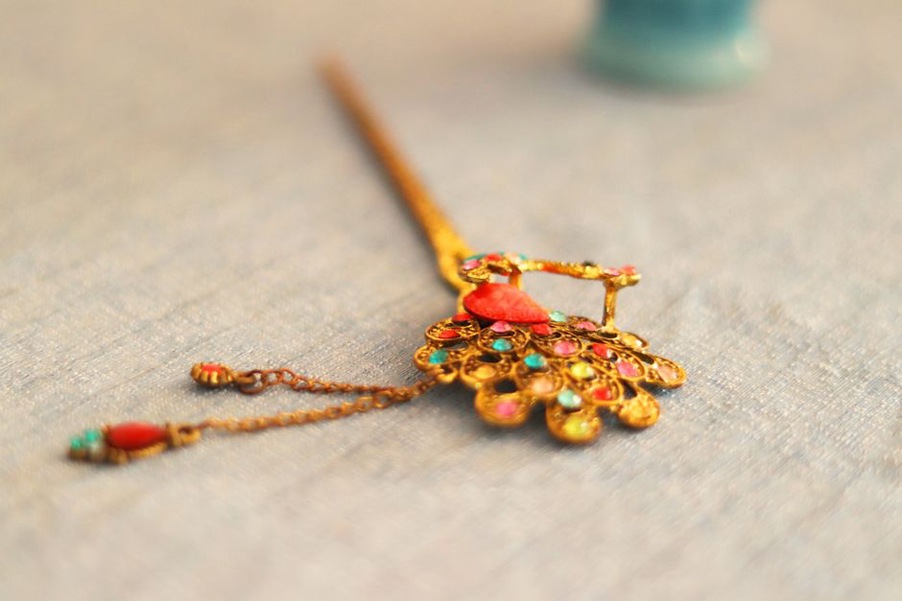
When a replacement changes the description
A replacement clasp can make a damaged piece wearable, but it changes what is being sold. Ask whether the seller knows if the mechanism is original. If they cannot tell, “vintage ornament with an uncertain or replacement fastening” is more accurate than “all-original vintage barrette”. The distinction may matter greatly to a collector; if you intend to wear it, a sound repair that has been clearly disclosed may be perfectly acceptable.
Read several clues together
No single colour, silhouette or clasp can authenticate a barrette. Materials were reused, fashions returned, and inexpensive accessories were rarely documented as carefully as fine jewellery. Start with a broad possible period, then see whether the clues agree.
- Construction: Is the decoration integral to its backing, riveted on, sewn to a support or glued in place? Does the method make sense for the materials?
- Materials: Does the seller describe what can be observed, or claim a specific material without testing?
- Fastening: Does its finish and wear relate to the rest of the object? Might it have been replaced?
- Surface: Are scratches, patina and losses where use would be likely to produce them?
- Provenance: Is there a dated photograph, original packaging or trustworthy history tying this particular barrette to an earlier period?
Those clues do not carry equal weight. A family photograph of a similar style gives context, not proof that the barrette for sale is the one pictured. Original packaging is stronger evidence when the piece clearly belongs in it; a loose card or box may have been paired with another accessory. A maker’s mark can help identify a manufacturer, but it still needs to agree with the construction. Marks can be copied, and marked components can be reused.
Materials: describe before you name
Listings often become less reliable when a visual impression turns into a firm material claim. A marbled brown barrette might be called tortoiseshell, but appearance alone cannot establish whether it is a natural material or a patterned substitute. Plastic, resin and other moulded materials can imitate older surfaces convincingly. If identification would affect legality, value or care, seek an appropriately qualified opinion rather than relying on a photograph or home test.
Early plastics, including those sold under historic trade names, invite similarly confident labels. Colour, translucency and a carved-looking surface may suggest a possibility; they cannot establish composition. Avoid heat, hot-water, solvent and pin tests. They can damage the piece and still leave you uncertain. “Unidentified early plastic” or “material untested” is more helpful than an exciting name without evidence.
Be just as cautious with metal. A silvery surface is not automatically sterling silver, nor does a warm gold tone establish gold content. Look for hallmarks or maker’s marks, and check whether they appear on the main ornament or only on an attached part. Plating may wear through at exposed edges, while darker recesses can hold deposits from age or cleaning products. Neither effect dates a piece by itself.
Glass stones, paste, beads and enamel deserve a look from behind, too. Settings, stitching and decoration bonded to a base each leave different traces on the reverse. A replacement stone may look brighter or sit higher than its neighbours. That could be an ordinary repair, but it should be mentioned in the description.
What genuine wear looks like
Age is not the same as dirt. A barrette kept in a drawer may be remarkably clean; a recent one worn every day can be scratched. Plausible wear tends to follow contact: small rubs on outer edges, fine marks where fingers open the clip, or finish loss where the clasp repeatedly meets its catch. On an embellished front, raised details may be more worn than sheltered recesses.
Uniform staining, even in hard-to-reach corners, is less persuasive than varied wear. So is a heavily distressed front with a pristine back, though cleaning or repair might explain the difference. Compare the surfaces in ordinary light, with a small magnifier if you have one. Do not scrape off deposits to investigate; you could take the original finish with them.
Patina can be interrupted
A polished front and darkened clasp need not be mismatched. Someone may have cleaned only the visible ornament. Equally, a replacement clasp can tarnish in storage. Patina is part of an object’s history, not a pass-or-fail test. Redundant holes, mismatched fittings or a join covering an earlier attachment point are usually more telling signs of replacement.
Use style for context, not proof
Silhouette can give you a place to start researching. A restrained geometric front might invite comparison with interwar design; a glittering curved one could recall mid-century dress accessories. Neither resemblance proves when it was made. Designers and mass-market makers have often returned to older shapes, and a plain functional barrette might have been produced over several decades.
Test a proposed date against the whole piece. Does the material suit it? Is the ornament constructed in a way that makes sense with its fastening? Could an alteration explain an older-looking front on a later clip? If a seller assigns a narrow decade only because something “looks 1950s”, regard that as a style description until more evidence appears.
Origin is another easy assumption to make. Finding a barrette in a British antiques shop does not mean it was made in Britain. Its British owner may have bought an import, and an unmarked piece rarely reveals how it reached a dressing table. “Found in Britain” describes its discovery; “British-made” needs separate evidence.
Marks and provenance: useful, but easy to overread
Ask for a clear, straight-on photograph of any mark, as well as a view of the entire reverse. Transcribe the letters, numbers and symbols exactly as they appear instead of turning an unclear stamp into a familiar maker’s name. A stamped word might identify a company, a material claim or the supplier of one component; it may not date the finished accessory. An unmarked barrette can still be authentic, particularly if its original label has been lost.
Packaging, receipts and personal histories are most useful when they can be connected to the individual piece. A barrette secured to a period card with matching wear is more persuasive than one laid beside a loose box. An inheritance story may be entirely sincere without establishing a manufacturing decade. Ask what supports the date and keep the seller’s answer with your purchase notes.
Photographs and questions that make buying safer
When you cannot handle a barrette, an attractive front view is not enough. Request sharp, unfiltered photographs in even light: the front, full reverse, open fastening, side profile and any marks, repairs or damage. A ruler beside the piece tells you more about scale than “medium size”.
- Ask for the barrette’s length and width and the usable length of its fastening. The decorative front may be much wider than the section that grips hair.
- Ask whether the clasp closes securely and whether it appears original, repaired or replaced.
- Check for missing stones, loose trim, cracks and lifting layers, including faults visible only from the side.
- Ask what supports the proposed date and material. “Unknown” is a useful answer when the evidence is limited.
- Keep copies of the description and photographs, especially if originality or provenance affects the price.
A high price does not authenticate a piece, and a low one does not prove it is a reproduction. Compare its condition and disclosed alterations with similar examples, allowing for the fact that an unusual design or documented history may have no close match. If an expensive attribution depends on an untested material or unreadable mark, factor that uncertainty into your decision.
Distinguishing a reproduction from an altered original
Three descriptions often get blurred. A period barrette was made as a hair fastening in the period claimed. A converted piece has an older ornament—perhaps a jewellery component—attached to a hair clasp later on. A reproduction is a later accessory made to resemble an earlier design. Any of them may be lovely to wear, but they should not be sold as though they are the same thing.
Look particularly closely at conversions: their decorative fronts really can be old. Attachment holes or traces of former fittings may reveal an earlier use. An unusually heavy ornament on a small clasp is another reason to ask how and when the two were joined. Reproductions can be beautifully made, too, so tidy workmanship proves little about age. State what the evidence supports rather than forcing a precise decade onto the piece.
Make a record before the first wear
Photograph a newly acquired barrette from the front and back, with the fastening open, before you clean or wear it. Record the seller’s date and material claims separately from what you can see yourself. You will have something to compare if a stone loosens, a joint changes colour or a spring begins to move differently. Store the piece so its clasp does not press into delicate decoration, and hold off on aggressive polishing while the finish is uncertain.
Suppose the ornament is darkened and riveted, but the clasp is bright. A note such as “decorative front appears older; fastening may be a later replacement; date and material unconfirmed” preserves what you actually know. It will still be useful the next time you examine the barrette.