
Edwardian Peacock Feather Hair Ornaments: History, Identification and Care
A single peacock “eye” at the side of an Edwardian coiffure could add far more than colour. Its iridescent blue, green and bronze rings showed up clearly against the period’s dark, softly arranged hair, while its exotic associations suited the decorative taste of the years before the First World War. It was not, however, an everyday accessory for every woman. Peacock plumage appeared most often in dressy millinery, theatre-influenced adornment and carefully built hairstyles rather than restrained daytime wear.
Why the peacock feather mattered in the Edwardian period
The Edwardian era, broadly 1901 to 1910 and often extended by fashion historians to the outbreak of war in 1914, favoured silhouette, surface detail and ornament. Hair was commonly swept into a broad pompadour or a low, full chignon, sometimes supported with pads, switches or false hair. These generous shapes provided a setting for combs, aigrettes, sprays, pins and small hats. Peacock feathers could be worked into the arrangement as sculptural accents rather than simple decoration.
The material also fitted wider artistic tastes. The late Victorian Aesthetic movement had established the peacock as a lasting motif associated with colour, luxury and Japanese-inspired interiors and design. That visual language was still familiar in the Edwardian years. A jewelled comb might echo a peacock eye, while enamel, glass or painted celluloid could imitate its distinctive colours without using feathers at all.
Feather ornament also belongs to a difficult history. The international plume trade supplied an enormous millinery industry, and fashionable demand contributed to the killing of wild birds. British campaigners, including the Royal Society for the Protection of Birds, opposed the trade for decades. The Importation of Plumage (Prohibition) Act 1908 was passed, though it was not implemented until 1921. Seen now, an Edwardian peacock-feather accessory is evidence of its period, not a reason to encourage indiscriminate new feather consumption.

From hat plume to hair ornament
Photographs, fashion plates and surviving accessories show how readily peacock feathers moved between hats and hairstyles. A large feather fan was more likely to be mounted on a hat or toque, while a smaller cluster could be secured in the hair with a wired stem, comb or hatpin-like fitting. This distinction matters when identifying an object today: an elaborate feather spray may have been intended for a hat, even if it can be placed in the hair.
Common Edwardian uses
- Side sprays: one or several feathers positioned above the ear, often following the upward sweep of a pompadour.
- Comb-mounted arrangements: feathers wired to a metal or tortoiseshell-effect comb, designed to disappear into dressed hair.
- Aigrettes: upright ornaments that gave height, sometimes combining feathers with paste, metal or imitation pearls.
- Evening hairpieces: restrained feather tips mixed with ribbon, velvet, flowers or jet-like beads for receptions, dinners and theatrical occasions.
- Hat-to-hair adaptations: detachable mounts that allowed an owner to move a decorative element between a small hat and an evening hairstyle.
Peacock plumage carried more visual weight than ostrich tips or marabou, which were valued for softness and movement. Its firm central shaft and graphic eye made it particularly effective as an accent. A full tail feather could be striking, yet awkward in close indoor settings and easy to overwhelm the wearer. Period styling more often relied on an asymmetrical grouping than a complete fan.
Colour, symbolism and the limits of symbolism
Modern descriptions often attach fixed meanings to peacock feathers: pride, immortality, protection, vanity or bad luck. Edwardian fashion did not follow one universal symbolic code. The peacock had long associations with splendour and display, and its eye-like markings were visually compelling, but a feather might equally have been chosen because it suited a blue-green gown or velvet-trimmed hat.
Superstitions were similarly uneven. Some theatre traditions regarded peacock feathers as unlucky, perhaps because the eye motif recalled the evil eye or because feathers were associated with difficult stage costumes. Such beliefs differed by place, occupation and family custom. It would be misleading to suggest that Edwardian women generally avoided them in their hair for fear of misfortune; fashion imagery and surviving millinery show that they were worn. Context is more useful than any single symbolic reading.
How an Edwardian feather piece was constructed
A genuine period ornament may appear delicate, but its structure was often practical. Feathers were commonly bound to wire with thread, tape or fabric, then attached to a base. That base might be a curved metal comb, a small buckram-covered pad, a bar pin, a hinged fitting or a wired stem designed to slide into the hair. Velvet leaves, silk flowers, sequins, imitation pearls, paste stones and ribbon could be added for detail.
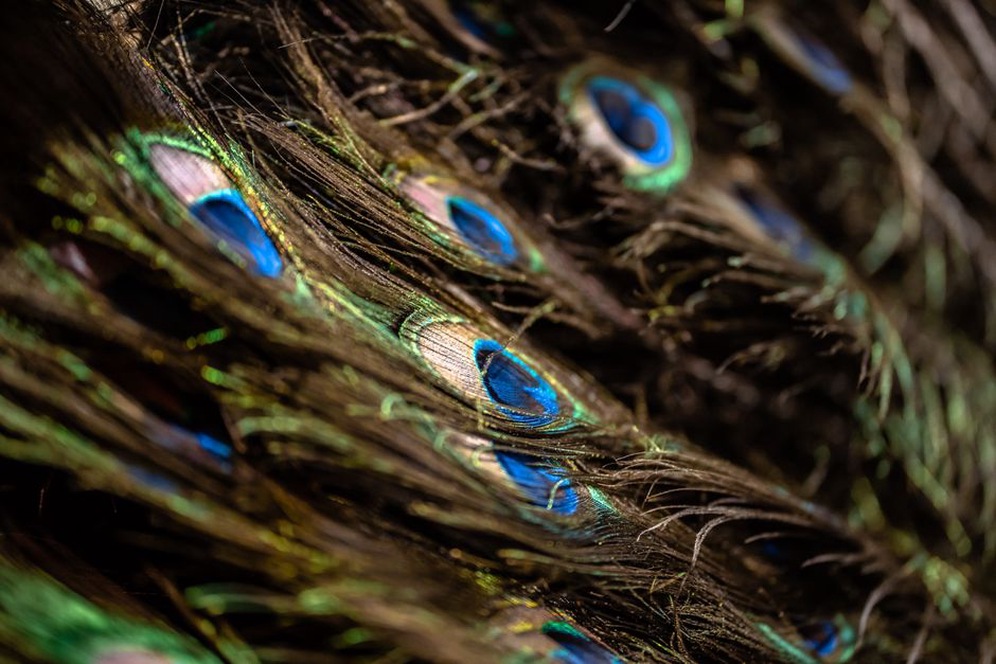
The feathers may have been cut, shaped, dyed, curled or combined with those of other species. Peacock tail coverts—the feathers with the familiar eye—are often called “tail feathers” in everyday speech, though the bird’s magnificent train is more complex than that shorthand suggests. In a vintage listing, a broad description such as “bird feather” is safer than a confident species claim when identification is uncertain.
| Feature | What it may indicate | What it cannot prove alone |
|---|---|---|
| Hand-bound wire stems | Older construction or careful later handmade work | An exact Edwardian date |
| Silk-covered or velvet base | Period-appropriate materials and mounting methods | That all elements are original |
| Darkened metal comb | Age-related oxidation or an intentionally dark finish | Authenticity without examining wear and construction |
| Peacock eye pattern | Use of peacock plumage or a convincing imitation | Whether the ornament was made for hair rather than a hat |
| Mixed old and new thread | Possible repair or remounting | That the piece lacks historical value |
Dating and assessing a vintage example
Peacock-feather accessories were produced before and after the Edwardian period, so colour is not a reliable dating tool. The mount’s shape, the fastening and the overall composition usually provide better clues. Edwardian examples often suit the ample, elevated hairstyles of the day: tall, curved or spreading forms with a light, theatrical outline. Pieces from the 1920s are often sleeker and sit closer to the head, while mid-century feather fascinators may use synthetic netting, plastics or different clip mechanisms.
A careful inspection routine
- Examine the attachment point. Look beneath the feathers for a comb, pin, wire loop or hat fitting. This often reveals intended use more clearly than the top view.
- Check for repairs. Replacement thread, newer glue or a recently added clip may be sensible conservation, but should be described honestly if the item is bought or sold.
- Assess feather condition. Brittle shafts, insect damage, bare patches and dusty barbs are common in old organic materials.
- Separate age from attribution. “Edwardian style” is not the same as “Edwardian.” Ask for provenance, clear photographs and mounting details before accepting a firm date.
- Avoid unnecessary testing. Pulling barbs, wetting feathers or aggressively bending wire can cause permanent damage.
Collectors should also watch for composite pieces. An antique comb may have acquired later feathers, or an original feather mount may have been fitted to a modern clip to make it wearable. Neither alteration automatically makes an object undesirable, but it changes how it should be described, valued and handled. A dealer’s certainty should rest on construction details, not the romance of the motif.
Using the look now without treating the past as costume
The strongest contemporary interpretation borrows Edwardian proportion and placement rather than recreating every element at once. A small peacock-coloured accent beside a low bun can suggest the period’s asymmetry without requiring a vast pompadour. For an evening event, deep teal, petrol blue or bronze fabric paired with a modest feather-inspired comb gives a clear reference even when no actual feathers are used.
Wear vintage feather pieces sparingly. Shafts can snap when pressed beneath tight elastic, caught under a coat collar or forced through densely pinned hair. Insert a comb once the hairstyle is finished rather than using it to build the arrangement, and support a wired spray with discreet hairpins placed beside—not through—the feather shafts. If the original mount is unstable, display or storage may be kinder than regular wear.
For a more durable twentieth-century counterpoint, a structured leaf motif can provide similarly directional ornament without featherwork’s fragility; the blog’s Collector's Guide to the Store P370 Leaf Hair Clip, a British vintage icon offers a useful comparison in form and collecting approach.
Care and storage for antique feathers
Feather ornaments need protection from crushing, light, moisture and pests. Avoid storing them in a bathroom, attic or damp cellar. A clean archival-quality box is ideal, though any sturdy box lined with acid-free tissue is better than a crowded drawer. Support the ornament so the plume rests in its natural direction, and make sure the lid is high enough not to flatten the barbs.
Dust calls for a light touch. A soft artist’s brush can lift loose surface dust when moved in the direction of the barbs; never scrub against their grain. Avoid water, hairspray, perfume, steam and household insect treatments. If you find signs of active insect activity—fresh powdery debris, detached fragments or larvae—seal the item away from other textiles and seek advice from a qualified textile or costume conservator.
When boxing an Edwardian peacock-feather spray, make a shallow nest of acid-free tissue beneath the wire-bound base. Lay the plume across the tissue without folding it. Keep the feather’s eye uncovered, and do not let the fastening rest on the shaft. This small precaution helps prevent a common break where old wire meets the quill.