
The Quiet Elegance of Vintage Romaine Clips: A Collector’s Guide
Few hair accessories are as easy to misjudge as the Romaine clip. In a mixed tray of 1930s barrettes it looks quiet, small, smooth, almost like a plain button. But its silk covering is not a separate decorative detail; it is the design. The metal spring is only a frame, and the hand-wrapped romaine ribbon is what gives the clip its soft pressure, low shine and long life.
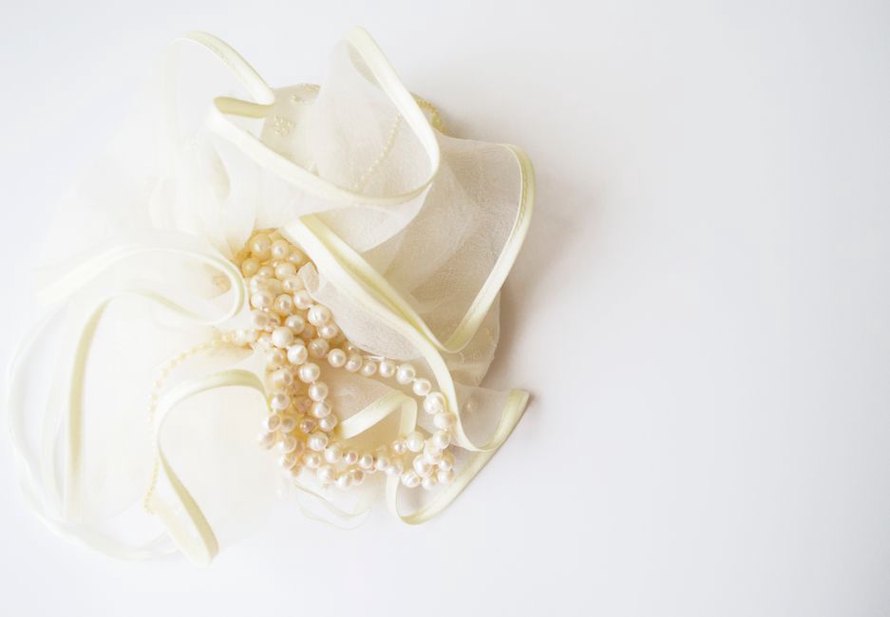
The material that gives the clip its name
Some collectors now use the name loosely for any ribbon-covered clip, but the original romaine ribbon was a specific trimmer's material. In the milliner's vocabulary, romaine is a closely woven silk ribbon with a faint, supple rib. Unlike grosgrain, whose hard transverse cords are made to hold the shape of a hat, romaine is fluid; when pulled tightly over a barrette frame, it produces a smooth, padded surface with a discreet sheen. The texture is what separates a true Romaine clip from a modern accessory with glued polyester ribbon. Polyester is slippery, feels flat and leaves visible glue along the rim. A proper romaine wrapping sits like a small cushion and remains taut across the whole top plate.
By the 1930s, rayon versions also appeared, and during the Second World War they became the norm for daily wear. Silk romaine remained the preferred surface for dress occasions, but rayon was accepted in the workroom because it had a similar softness and was far cheaper. Both are collectable; both simply need to be kept out of strong sunlight.
Anatomy of a Romaine clip
What really matters in a Romaine clip isn't the visible face—it's how the ribbon wraps around the simple spring frame. Underneath the silk are:
- a steel or brass back with two flat wings;
- a long hinge with a small lever;
- a shaped tension spring that holds the clip closed;
- a wrapping of romaine ribbon, folded over the metal edges and turned in at the rim;
- sometimes a single pearl, a silk bow or a tiny tortoiseshell accent on top.
Good fabric-covered clips never glue the ribbon into the hinge channel. The ribbon ends are folded just short of the hinge, which keeps the lever working smoothly for decades. Check this when you're buying: if the ribbon has found its way into the hinge, the clip will be stiff and much more difficult to open.
Shapes a collector will recognise
Romaine products range from tiny side clips to long dressmaking barrettes. Five classic profiles appear again and again:
| Shape | Length | What to look for |
|---|---|---|
| Slim oval | About 5 cm | Sits flat beside a side part; the most useful first buy. |
| Double waved | 6–7 cm | Follows the curve of finger-waved hair; check that both waves are even. |
| Rectangular with bow-tie ends | About 8 cm | Good holding power; the tied ends catch the light beautifully. |
| Rounded thumbprint | 4 cm | Best for short hair and wispy ends; look for a clean, smooth dome. |
| Scalloped leaf edge | 6–8 cm | Decorative and slightly more fragile; inspect the scallops for missing ribbon. |
The most sought-after examples are not necessarily the most decorated ones. The finest Romaine products are those where the ribbon is so tightly wrapped that the metal frame almost disappears; the clip reads simply as a soft line of colour.
The twentieth-century silhouette
Romaine clips survived because they answered a changing need. In the 1910s and early 1920s, when hair was swept into wide, flat chignons, a long silk-wrapped clip could secure a mass of hair without leaving a hard line. In the 1940s, when shorter shapes and rationed accessories appeared, the compact 4 cm Romaine clip was a sensible afternoon piece. From the late 1940s into the 1950s, brighter pearl-accented versions accompanied the fuller line of a roll curl; they sat on the top of the head rather than at the side. This flexibility is why old dealer catalogues sometimes describe them as all-purpose hair ornaments.
Finding vintage Romaine clips in Britain
The classic places for Romaine clips are not necessarily formal antique shops. They often hide in the boxes that dealers call dressing-table odds and ends. Because the silk is muted and the shape is quiet, a Romaine clip is rarely displayed as the centre of a stall. Ask specifically for old hair ornaments, or look through a jar of mixed barrettes at a village fayre. Charity shops and vintage clothes fairs in Bath, Lewes and Stamford are particularly good hunting grounds.
Few examples survive with their original card. The cards were small, printed with a line drawing of a curled hairstyle and a phrase such as pure silk or washable silk, and they were usually thrown away as soon as the clip was bought. So when a card does appear, it is worth preserving as documentation rather than discarding it with the paper.
What to check before you buy
- Flex the hinge slowly. It should be smooth from the first centimetre, not jerky.
- Look at the top rim. The ribbon should be turned in and pressed flat, not frayed or lifting.
- Check the underside for rust. Light surface bloom can be dealt with, but pitting around the hinge is a sign of a shorter life.
- Smell the clip if possible. A strong mothball scent means it has lived in an attic where silk and paper may have weakened.
- Test the spring on your hand, not your hair. The clip should close with a clear click and hold a small piece of tissue without crushing it.
Wearing a Romaine clip with modern clothes
The best way to wear a Romaine clip is as a single accent at the side of a low knot or tucked behind a bar of hair where a modern claw clamp would feel too heavy. It works with a fine knit cardigan, a cotton poplin dress and even a tailored suit, because its surface has no logo and no obvious period marker. Choosing one old Romaine clip over several new plastic accessories is also a practical way to buy less; it needs no packaging and no spare parts.
One useful trick is to treat it as a companion to other wrapped accessories. The low-tension logic that keeps a Romaine clip from pulling hair is the same logic behind a braided headband: it should sit on the hair rather than squeeze it. If you enjoy that kind of construction, our Georgia Maxi braided headband guide explains how a wrapped fibre can hold a style without constant adjustment.
Care, storage and small repairs
Romaine clips need very little care, but the small rituals matter. Keep the clip closed when it is not being worn. Closing it protects the spring and stops the silk from catching on other jewellery in a drawer. Store it flat in a lined box, with acid-free tissue between clips; never hang it by the spring.
After a day of wear, wipe the metal underside with a dry lint-free cloth to remove moisture. If the back becomes dry or squeaky, place the tiniest dot of microcrystalline wax on the hinge and open and close it once. Do not use oil, water or sewing-machine lubricant.
If the ribbon begins to lift at the rim, do not iron it. Press it back into place with a dab of acid-free bookbinding glue on a pin, then close the clip on a flat piece of glass and leave it for an hour. This is only worth attempting if the surrounding silk is still intact; if the surface has turned powdery, let the clip retire and look for another with a cleaner wrap.
If you are new to Romaine clips, start with a single 5 cm oval: not the rarest, not the fanciest, but the clearest expression of why this small category endures. Test it, wear it once at the side of a half-up twist, store it closed, and see how a simple piece of silk and spring can carry the quiet character of vintage British dressing-table style.