
1950s Silk Headscarves: Practical Hair Accessory or Fashion Statement?
A square silk scarf tied beneath the chin, over a set curl or around a ponytail could change a 1950s outfit without the expense of a new dress. Its modest size was deceptive. The same printed square might protect a hairstyle on a windy bus ride, pick up the colour of a cardigan, or provide the sharpest note against a restrained wool coat.
In 1950s Britain, the silk scarf was both practical and expressive. It contained, covered or secured the hair, while its print, placement, material and relationship to the rest of an outfit made a statement. Those roles often overlapped. Its adaptability suited a decade that valued polish, coordination and making the most of what one owned.
A modest square with a visible role
Scarves had appeared in hairstyles long before the 1950s, but post-war fashion gave them renewed visibility. Fuller skirts and considered silhouettes called for well-finished accessories, while ready-made clothes and home dressmaking made colour coordination more attainable. A scarf was portable, adaptable and less costly than a new coat or hat. It could revive an outfit already in regular rotation.
Silk was not the only material in use, nor was every silk scarf intended for the hair. Rayon, cotton, wool and synthetic blends were widely worn, particularly day to day. Silk had particular appeal because it draped neatly, held printed colour well and looked refined when knotted simply or folded into a narrow band. Surviving examples may carry “pure silk” labels, hand-rolled hems, souvenir borders or signature-style prints, but none of these details alone proves a date or prestigious maker.
Cinema, fashion magazines and advertising often associated headscarves with travel, leisure, glamour and an off-duty air. In daily life, the meaning was more flexible. A woman cycling, shopping or travelling could shield a styled set from weather and dust, then still look suitably put together for a café, station platform or afternoon visit.
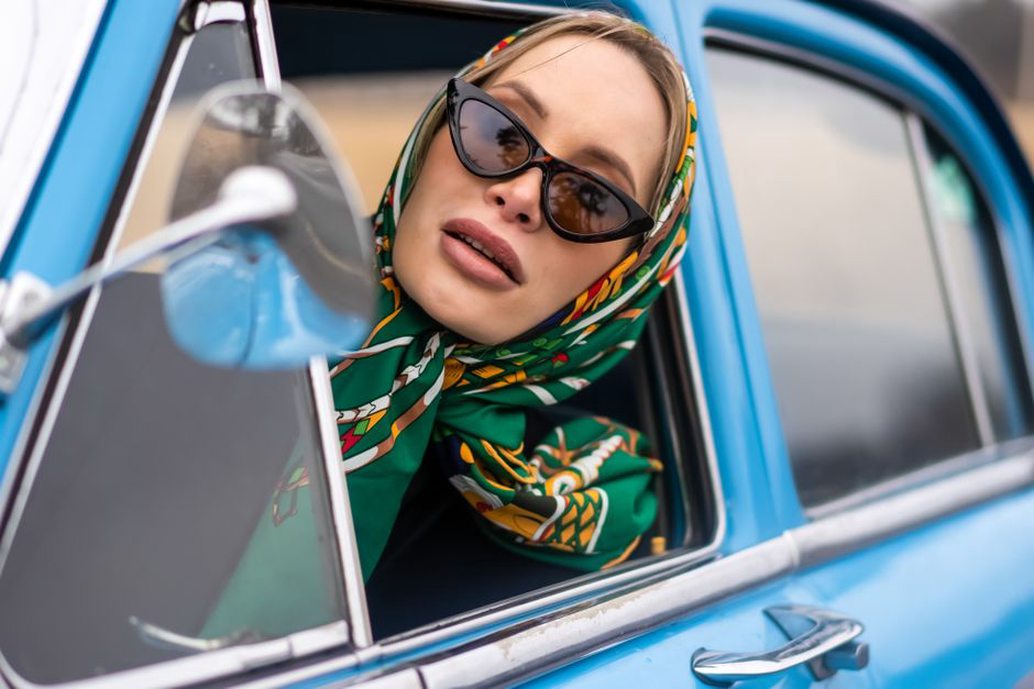
How the scarf worked in the hair
The best-known 1950s arrangements began with a square folded into a triangle or a long strip. These folds did more than decorate the hair: each controlled a different amount of coverage and changed the balance around the face.
The under-chin tie
Fold a square diagonally into a triangle, place it over the head and tie the ends beneath the chin. The style covers the crown while leaving part of the front hairline visible, protecting a set hairstyle and framing the face. For modern wear, placing the knot just under rather than directly in front of the chin usually feels less theatrical while keeping the period reference.
The top knot or “rosie” arrangement
A scarf folded into a band and tied above the forehead gives a more casual, workwear-adjacent outline. Contemporary styling often connects it with 1940s imagery, but it remained in informal use during the 1950s. Its current popularity can encourage overconfident dating: a knot at the top of the head is not reliable evidence of a particular year.
The neck-to-hair transition
A small scarf might be worn at the neck, then drawn over the head when required. That simple change explains why scarves resist neat categorisation. A square carried as a neckerchief could become hair covering in rain, during an open-vehicle drive or on a breezy walk by the sea.
The ponytail or updo accent
Narrow-folded silk could be tied around a ponytail, threaded through an updo or used to finish the base of a bun. It worked much like ribbon, though its sheen and print gave it greater visual presence. Today, it is especially effective against a simple outfit: denim, a plain knit and one patterned scarf can nod to the period without looking like costume.
Hair accessory versus fashion statement: the useful distinction
How a scarf is worn can suggest its main purpose, though context always matters. These distinctions are useful guides, not fixed rules.
| Primary use | Typical placement | What it communicates |
|---|---|---|
| Hair control or protection | Triangle over the crown, tied under chin or at nape | Practicality, neatness and dressing suited to movement |
| Hairstyle finishing | Band around ponytail, bun or rolled hair | Colour coordination and a deliberately finished look |
| Outfit focal point | Bold print visible around head and face | Graphic contrast, personality or a travel-inspired mood |
| Convertible accessory | Alternates between neck, bag handle and hair | Adaptability and resourceful styling |
The distinction is particularly useful when styling vintage pieces. A highly patterned scarf paired with a patterned dress, a large brooch and several prominent hair ornaments can bury the scarf’s charm. A 1950s-inspired outfit usually reads more clearly when one accessory takes the lead and the rest stay quieter. If the scarf is the focal point, choose unobtrusive earrings and a simple fastening. If a sculptural comb or clip is central, use a quieter scarf or wear it at the neck.
Scarves also offered a softer alternative to structured headwear. Hats remained important throughout the decade, but a silk square left the hair visible and could be folded away easily. It allowed the degree of formality to shift with the occasion.
Print, colour and scale in the 1950s vocabulary
Period scarves ran from restrained solids to exuberant novelty prints. Florals, polka dots, paisleys, abstract brush marks, equestrian motifs, souvenir scenes and border designs all appeared in mid-century wardrobes. A design was often meant to be glimpsed in fragments: a border at the forehead, a flash of motif beside the knot, or a triangle of colour at the back of the head.
- Border prints work particularly well for head ties because the edge stays visible after folding. Look for an evenly placed border that will not disappear completely into the knot.
- Small-scale florals and dots pair easily with plain knitwear, shirt dresses and tailored coats.
- Large scenic or novelty motifs may work better at the neck or on a bag if the design becomes unreadable after folding. They can still suit the hair when the motif is deliberately centred.
- Solid silk squares depend on colour and texture for their effect. Deep red, navy, cream, bottle green and clear mid-century pastels all have plausible period associations, though none belongs exclusively to the decade.
Scale often matters more than a supposedly “vintage” colour. A small scarf may be ideal for a ponytail but too narrow to cover a set hairstyle. A larger square offers more options for a head wrap, yet can overwhelm a small frame if too much fabric is gathered at the neck. For a practical headscarf, squares of around 65 to 90 centimetres are often easier to fold and secure than very small kerchiefs, although vintage dimensions vary widely.
Recognising a genuine mid-century scarf without overclaiming
Textiles are rarely dated with complete precision. A hand-rolled hem, fine silk and an appealing print may suggest good manufacture, but they do not prove a 1950s date. Motifs were revived, manufacturers reused designs and later scarves can closely resemble mid-century examples. The responsible approach is to consider several clues together.
Details to examine
- Hems: Hand-rolled edges are associated with fine scarf finishing, but machine-stitched hems also appear on authentic older scarves. Check that rolling is consistent and stitching neat rather than assuming one method is automatically superior.
- Labels: Fibre labels, country-of-origin wording, brand marks and care instructions can offer useful evidence. Where possible, compare typography and construction with securely dated examples, but do not rely on a label that is damaged, missing or easily copied.
- Print registration: Look at how sharply colours align and whether the reverse shows colour penetration consistent with the printing method. Small irregularities may reflect age or production methods rather than handmade work.
- Wear pattern: Fading along folds, softened corners and small pulls can be consistent with use. They do not prove age, as newer scarves can be heavily worn too.
- Provenance: A receipt, family history, original packaging or a clearly documented collection is valuable. It should still be described accurately rather than embellished.
Be wary of broad claims such as “1950s designer silk” when the evidence supports only “mid-century style” or “vintage silk scarf”. Careful descriptions protect buyers and the object’s history. A later scarf can be beautiful and entirely appropriate for a 1950s-inspired hairstyle without being presented as something it is not.

Styling a 1950s reference with a contemporary wardrobe
The most convincing current interpretations tend to borrow one period idea rather than reproduce every element. A silk scarf can soften a sharply cut blazer, bring colour to a trench coat or add movement to a plain jersey dress. Its 1950s character comes as much from its fold and finish as from the print itself.
For a weekday outfit, fold a 70-centimetre square into a long band, place its centre at the nape and tie it once above a low ponytail. Keep the ends short instead of making a large bow. Worn with a white shirt, dark trousers and loafers, it adds a restrained mid-century note.
For a coat in wet weather, use the triangle fold over the head and tie the ends at the nape rather than beneath the chin. This keeps the shape practical and avoids crowding the collar. A scarf with a narrow contrasting border works particularly well, as the edge outlines the face without requiring a matched outfit.
For evening, fold a plain silk square into a narrow band and weave it through a low chignon or tie it around the base. Keep the knot below the bun, where it is visible in profile. If you prefer more structure near the crown, a soft headband can provide it; the history and styling advice in The P379 Velvet Braided Headband: History, Identification, and Styling Tips offers a useful contrast to silk’s fluid line.
Handling and storing silk with care
Silk is strong for its weight but susceptible to abrasion, long exposure to light, moisture marks and sharp jewellery. Vintage examples may be weakened along fold lines, especially where they were repeatedly knotted. Before wearing one in the hair, inspect it in good light for tiny holes, thinning, colour transfer and loose hand-rolled stitching.
- Remove hair grips, pins and brooches before untying the scarf so they cannot catch the weave.
- Avoid spraying fragrance or styling products directly onto silk. Marks can be difficult to reverse and may affect the colour.
- Do not pull fragile vintage silk into tight knots. A loose double knot, or a small concealed elastic beneath the scarf, can reduce strain.
- Store clean, dry scarves flat in acid-free tissue, or loosely folded with tissue at the creases. Keep them away from direct daylight and damp conditions.
- Test colourfastness only with great caution. For a valuable or badly stained piece, seek a specialist textile conservator rather than experimenting with home cleaning.
One sensible approach is to reserve a delicate original for loose neckwear or drawer display, while using a newer silk or silk-blend scarf for frequent hair styling. This respects a textile that has already lasted several decades while retaining the visual language of the 1950s.
For occasional wear or display, follow existing creases rather than introducing sharp new ones. Put a smooth, fabric-covered elastic around a low ponytail first, lay the scarf over it and make one loose knot around the elastic. The silk supplies the colour and period character without taking the full strain of holding the hair in place.