
Victorian Hair Combs: Reading the Silhouette and Wearing It Today
The teeth of a Victorian hair comb disappear into the hairstyle; the decorated crest remains in view. That is how a small object can create such a distinct outline: a compact fan, a pierced arch or an upright spray above the hair. The crest may look delicate, but it is the length and spacing of the teeth that determine how securely the comb sits.
What made the silhouette Victorian?
There was no single Victorian comb. Hairstyles changed over the reign, from 1837 to 1901, and combs changed with them. Mid-century hair was often smoothed around a centre parting, with plaits or a bun behind. Later styles could build more height at the back and crown. A comb might help secure an updo or simply add ornament alongside pins. Small side combs and taller back combs gave quite different outlines.
Look where the teeth meet the crest. Some designs keep the decoration low and broad, following the curve of the head. Others raise it into an openwork fan, letting the hair show through. Floral scrolls, leaves and geometric borders all added height without forming a solid slab. That contrast between an anchored base and an airy upper edge often says more about the Victorian look than any single motif.

Scale changes the effect
A modest pair of side combs can nearly disappear against dark hair, leaving two glints near the temples. A tall back comb draws a clearer line above a bun. Neither shape proves a precise date: makers reused popular patterns, and later accessories borrowed nineteenth-century forms. Height, colour and floral decoration are clues to describe, not shortcuts to dating.
Materials beneath the decoration
Surviving combs include examples made from horn, tortoiseshell, early plastics and metal, sometimes in combination. They may also have paste stones, gilt details or small mounted ornaments. A dark comb is not automatically tortoiseshell; a pale, translucent one is not necessarily horn. Colour is easy to imitate. Construction and surface condition can tell you more, though identifying a material may still take specialist knowledge.
Horn may show subtle shifts in tone and a fibrous-looking structure; shell can have depth and irregular mottling. Neither observation is a definitive test. Avoid heat, solvents and scratching: they can damage a comb without settling the question. If a seller attributes one to a particular century or material, ask what supports that claim and whether repairs or replacement teeth have been disclosed. Before buying a comb that may contain protected wildlife material, check the UK rules on acquisition and resale.
Turn the comb over, too. Is the crest part of the same piece as the teeth, or is a decorated fitting attached to a separate base? Rivets, hinges and settings may be original. Fresh adhesive, mismatched colour or an unusually clean tooth may point to later work. A repair does not make the comb less interesting, but it affects how confidently you can date it—and whether you should wear it.
Reading a comb without claiming certainty
“Victorian-style” describes a look; “Victorian” makes a claim about age. Unmarked combs can be hard to place, since forms carried into the Edwardian period and returned in later revivals. Begin with what you can see:
- Profile: Note the crest’s height and width, and whether its outline is symmetrical.
- Teeth: Check their number, spacing and tips, and whether they follow the same curve.
- Construction: Look for separate mounts, visible fixings and replaced parts.
- Condition: Record cracks, loose settings and areas that flex under very light handling.
- Provenance: Keep any credible family history, dated photograph or earlier inventory with the comb.
None of these details gives you a reliable year on its own. A photograph might establish that a comb was in a family at a certain time, but not when it was made. Patina can be imitated, and old-fashioned shapes were sometimes produced decades after their first popularity. “Pierced brown comb with a metal-mounted crest” is more useful than a date you cannot support.
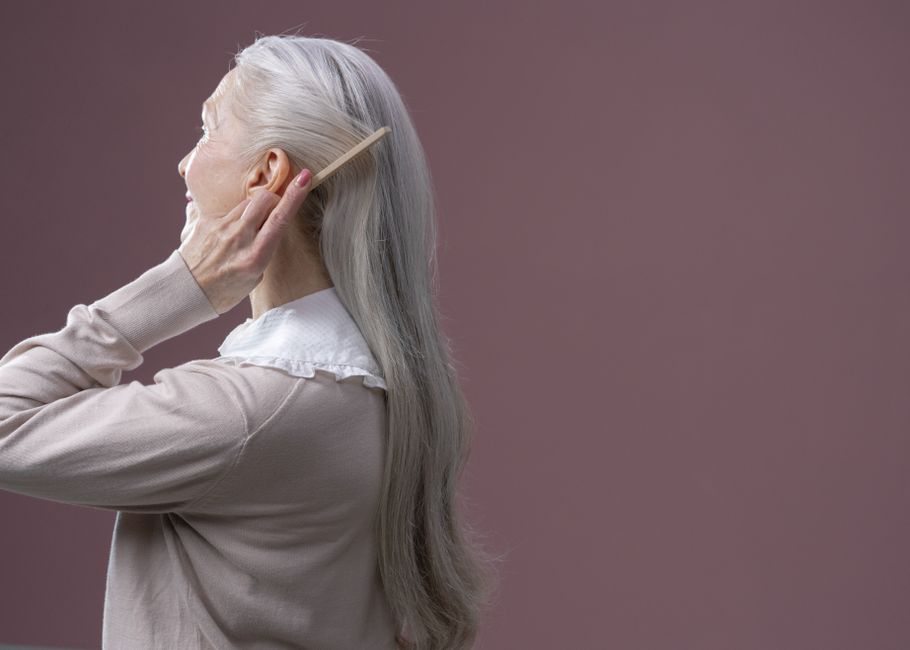
How to give the shape a modern setting
Let the outline show. A low, fan-shaped comb can sit above a simple twist; a taller crest can rise just behind a bun, with only its decorated edge visible. A plain shirt, fine-knit jumper or unembellished dress leaves intricate openwork easy to see. It is a question of visual balance, not a rule about who can wear an ornate accessory.
If the comb is an original, try the arrangement gently at home before wearing it out. Secure the hairstyle with ordinary pins first, then slide the comb into place rather than making fragile teeth carry the full weight. Stop if the base catches or the crest moves independently. For frequent wear, travel or a style you will need to readjust, a recent comb inspired by Victorian shapes is more practical. It can have the same outline without being passed off as an antique.
Keeping the crest intact
Lift a comb by its sturdy base, not an openwork tip or mounted flower. Dust it with a soft, dry brush, and do not immerse mixed materials: water can reach joins or settings hidden from the front. Store it separately, with support beneath it so the teeth do not bear the crest’s weight. If a tooth is cracked or a mount feels loose, leave the comb unworn until a conservator or experienced repairer can assess it.
Before putting it away, photograph the front, reverse and tooth tips against a plain background. Note its width and any movement at the join. Months later, those details will tell you far more than a memory that it once felt sound.