
The 1980s Hair Accessories Worth Revisiting
A wide satin scrunchie changes the outline of a ponytail in a way a narrow elastic cannot: the fabric becomes part of the hairstyle. That visible volume is one of the clearest 1980s ideas in hair accessories today. You can see it in oversized bows, padded headbands and clips large enough to register against a simple outfit. The appeal lies less in recreating a decade than in borrowing its confidence in scale.
What made an accessory look distinctly 1980s?
There was no single eighties look. A neat bow worn with smart clothes, a colourful plastic clip and a glittering evening slide belonged to different wardrobes. What connected many of them was a willingness to let the fastening show. An accessory could frame the face, interrupt a hairstyle with colour or make an everyday ponytail feel considered.
Shape mattered as much as decoration. Bow loops could be broad enough to show from the front; padding gave a headband height; gathered cloth made a scrunchie into a soft ring. Glossy moulded plastics, acetate, metal, velvet, satin and printed fabrics all offered ways to make an impact. Fashion magazines, television and music videos helped spread striking looks, though the version on a British high street might be much simpler than an editorial photograph: a fabric-covered elastic, a broad band or a bright slide.
That is why an accessory need not be neon to evoke the eighties. A black velvet bow and a jewel-toned satin scrunchie both have the period’s emphasis on visible shape. Equally, a colourful old clip is not automatically an eighties design. Its construction, proportions and finish tell a more useful story.
How the shapes returned
The scrunchie became an outfit detail
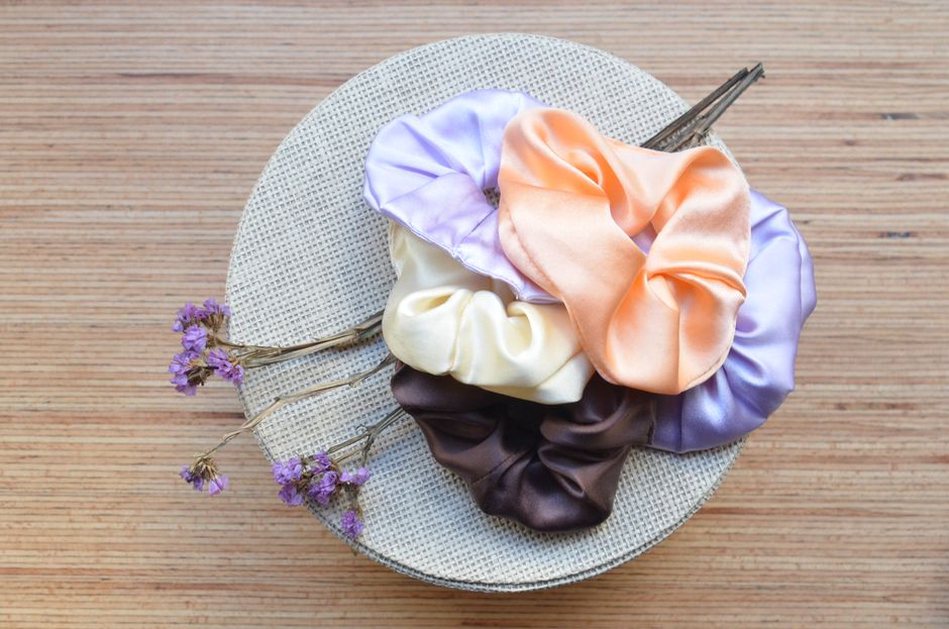
Scrunchies were widely worn during the 1980s, when a fabric casing made an elastic fastening impossible to miss. Modern versions keep the gathered ring but change its character. A compact cotton scrunchie feels casual; a broad one in satin or organza gives the more pronounced outline associated with the decade. Around a low ponytail, it can supply plenty of volume on its own.
Context changes the effect. Against a plain jumper, denim jacket or sharply cut blazer, gathered fabric looks like a deliberate contrast rather than part of a fully coordinated eighties outfit. It also shows the difference between revival and preservation: a newly made scrunchie can borrow the silhouette, while an original carries the materials and construction of its own time.
Bows and headbands gained presence
Bows long predate the 1980s and have returned to fashion many times. The eighties contribution was a taste for assertive proportions: broad loops, generous tails and fabrics that held their shape. Today, a large bow can have much the same effect even on a plain black barrette. Set one above a low ponytail and it becomes a focal point at the back; place several small bows through the hair and the effect is busier and more decorative.
Wide and padded headbands make a similar point. Their height is visible from the front, almost like a soft architectural line. Recent versions include smooth monochrome fabrics as well as pearls and other embellishments. That does not make every padded band an exact eighties revival. It means the headband can be a feature, not just a way to hold hair back.
Clips brought colour into ordinary dressing
Large clips, slides and combs made practical fastenings visible. In the eighties, a shiny plastic barrette or metallic slide could bring a conspicuous patch of colour to an everyday style. Oversized acetate clips and graphic metal shapes do much the same now, especially with pared-back clothes. A translucent clip can recall the period’s playful materials without copying a particular design.
Claw clips often get swept into the revival, although their popularity spans more than one decade. Calling every claw clip an eighties object flattens that history. The closer connection is in what you see and how it works: an exposed mechanism, a substantial outline and a quick way to gather hair all suit a taste for accessories that do not hide their purpose.

Original piece or contemporary interpretation?
For a vintage shopper, the distinction matters. An accessory sold as “eighties-style” may be new; something labelled “vintage” may come from a later decade. Names and styling photographs cannot establish age. Turn the piece over and look at its construction before judging it by the front-facing silhouette.
- Check the fastening. Open and close a barrette or clip gently. For regular wear, a working hinge and secure catch matter more than an attractive front.
- Examine joins and coverings. On a bow, look where the fabric meets the clip. On a padded band, check the ends and underside for loose covering or exposed structure.
- Assess the material honestly. Plastic, acetate and fabric can all be appropriate to the period, but a finish alone rarely gives you a precise date.
- Read descriptions literally. “In the style of the 1980s” describes an influence, not an origin. When buying at a distance, ask for clear photographs and measurements.
Wear and patina offer clues, not proof: an older piece may look remarkably fresh, while a newer one may be damaged. A designer attribution needs more than a familiar-looking label, too. If provenance affects the price, ask for credible documentation rather than paying a premium for an unsupported claim. An unlabelled bow with sound stitching may serve you better day to day than a piece whose appealing story comes with a faulty catch.
Using eighties scale without dressing in costume
Start with the line you want an accessory to make. A wide bow adds width; a padded headband adds height; a scrunchie makes a rounded shape around a ponytail; a long slide draws the eye along one side. Thinking about shape is often more useful than matching every colour in an outfit.
One strong piece can leave room for the clothes. A burgundy velvet bow with a grey coat and plain knit feels quite different from the same bow worn with large earrings and a patterned headband. Neither is wrong, but the first leaves the bow to carry the eighties reference. For something quieter, repeat a colour from your clothes and change the texture: navy satin against navy wool shows through its sheen rather than a colour clash.
Match the size of the piece to its fastening and the hairstyle, not to a rule about who ought to wear it. A heavy clip may slip if its spring cannot manage the section of hair; a large bow may sit better on a ponytail held by a separate elastic. Let a discreet fastening do the holding and the vintage piece provide the visible detail. An older hinge or fabric casing will take less strain that way.
Keeping the details usable
These accessories invite handling, but materials have different limits. Store fabric bows where their loops will not be crushed, and keep pressure off padded bands so their coverings retain their shape. Do not force a rigid clip over a thick section of hair. A sound plastic or metal surface can be wiped carefully with a soft, dry cloth; avoid soaking pieces with glued decorations, aged plating or materials you cannot identify. Test any cleaning method on an inconspicuous area first.
An original scrunchie can look sound even after its elastic has lost its stretch. If the fabric matters to you, consider whether the inner elastic could be replaced without sacrificing the original construction. Sometimes careful storage is the better choice. Decide whether you have a wearable accessory or a delicate surviving example before putting it into daily use.
To try a broad bow, fasten a low ponytail with a separate elastic and set the bow just above it. Check the shape from the front and side, not only the back. If the loops vanish behind your head, move the bow a little higher; if the clip pulls, rest its weight on the secured ponytail rather than asking an old catch to hold everything.