
Why a Semi-Precious Stone Bracelet Belongs in Your Hair (and How to Wear It)
A semi-precious stone bracelet with the catalogue reference P637 is not the first thing you expect to find in a hair-accessory archive, yet it belongs there. Its beads are small enough to sit neatly against a bun, its cord is flexible enough to wrap around a ponytail, and its clasp is simple enough to hide under a strand of hair. In the Maison Archives system, P637 is filed under “bracelets”, but the longer you look at it, the more it behaves like a vintage hair cuff.
What Is the Store P637 Semi-Precious Stone Bracelet?
The Store P637 is a vintage-style bracelet made from semi-precious stones, usually rose quartz, amethyst, carnelian or agate. The beads are typically 4 to 6 millimetres across, which is the same scale as many Edwardian hair pins and 1920s headbands. They are strung on a flexible cord, with a small brass or silver-tone clasp. It is not a precious heirloom piece; it is a wearable, everyday accessory that was made to be handled.
The term “semi-precious” is a broad category, not a judgement. It covers natural minerals that are not classified as precious stones, such as diamond, ruby, sapphire and emerald. Amethyst, rose quartz, carnelian, agate and lapis lazuli all belong to this group. In vintage accessories, these stones were chosen for their colour, pattern and durability. A bracelet like P637 would have been sold in a department store or a market stall, not a high jeweller, which is exactly why it survives in such numbers.
The P637 bracelet is often found in a small box with a label that says “semi-precious stones”. The stones may be faceted, smooth, or a mix of both. Faceted beads sparkle more; smooth beads feel more organic. The cord may be a single strand or a double strand. Some versions have a small spacer bead between stones, usually brass or silver-tone. These details matter for dating the piece and for deciding how to wear it.
A Short History of Stone Jewelry in British Hair Fashion
Wearing stones in the hair is older than the bracelet itself. Victorian and Edwardian women pinned their hair with combs set with jet, tortoiseshell and, later, small stones. By the 1920s, British women wore beaded “headache bands” across the forehead; these were often made of tiny glass or stone beads on a flexible band. The idea of a stone bracelet in the hair is a direct descendant of that fashion. By the 1960s, Carnaby Street boutiques sold stone bead hair ties alongside velvet headbands. The P637 is a later echo of those ideas. The P312 tortoiseshell hoop from Maison Archives shows how a single material can define a vintage hair clip, while the stone bracelet works through colour and repetition.
In the 1930s, women wore snoods and hair nets, and beaded hair pins were popular. In the 1950s, chignon buns were often decorated with a single jewelled pin. The stone bracelet as a hair cuff fits into this longer story of using small, flexible ornaments to finish a hairstyle. The velvet scrunchie of the 1990s, such as the P306 black velvet scrunchiebow, became a separate collector’s category, but the stone bracelet never quite disappeared. It simply moved between wrist and hair. In British fashion, the line between jewellery and hair accessories has always been porous. A bracelet that can be wrapped around a bun is a perfect example.
Materials and Craftsmanship of the P637
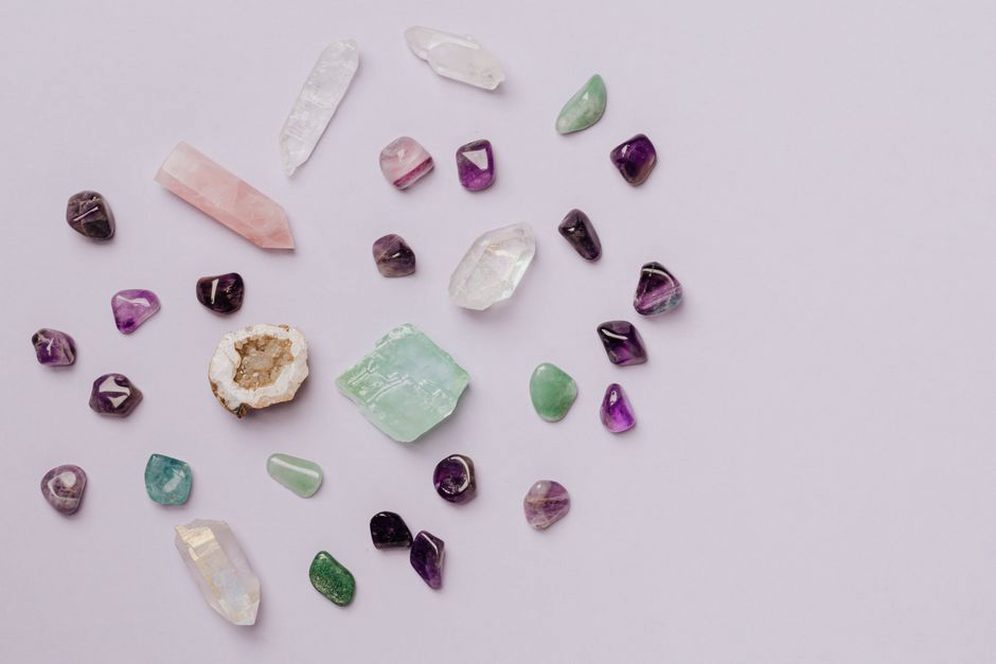
Identifying the stones in a P637 bracelet is part of the fun. Rose quartz is soft pink and often cloudy, with tiny internal cracks that catch the light. Amethyst is purple and rarely uniform; it usually has pale or white zoning where the crystal grew. Carnelian is translucent orange to brownish red, often with a smooth, waxy surface. Agate shows fine bands of colour, and it is frequently dyed to produce bright blues, pinks and greens. Natural stones usually show small variations in tone and pattern. These variations are part of their charm.
- Rose quartz – soft pink, often cloudy, with tiny cracks.
- Amethyst – purple with pale or white zones; can be faceted or smooth.
- Carnelian – translucent orange to brownish red; often smooth and waxy.
- Agate – fine bands, often dyed in bright colours.
- Lapis lazuli – deep blue with golden pyrite flecks; softer than quartz, so it needs gentler handling.
The cord is as important as the stones. A P637 in good condition will have a flexible cord that springs back when bent. If the cord is stiff or cracked, the bracelet should be re-strung before you wear it in hair. The clasp is usually a small brass or silver-tone spring ring. A good clasp will open and close with a light click; a bent clasp can catch hair. Because the bracelet is meant to be worn on the wrist, the clasp is often small enough to hide under a bead.
How to Wear a Semi-Precious Stone Bracelet in Your Hair
Because the bracelet is flexible and closes with a clasp, it works as a hair cuff. The simplest method is to wrap it around the base of a low bun. First, gather hair into a ponytail and twist it into a bun. Secure with a hairpin or a plain elastic. Open the P637 clasp, wrap the bracelet around the base of the bun, and close it. Tuck the clasp under a stone so it does not show.
- For a ponytail: secure with a plain elastic, then wrap the bracelet around the elastic to hide it. If the bracelet is long, wrap it twice.
- For a braid: slide the bracelet over the end of the plait, or thread it through the braid at the nape. It works especially well with a loose, textured braid.
- For a half-up style: use the bracelet to hold a small crown section, like a barrette. This is the quickest way to add colour without changing your whole hairstyle.
- For a wrist: wear it as intended. The same stones catch the light nicely when you move your hands.

Storing and Caring for the P637
Store the P637 in a separate pouch or a lined box. Semi-precious stones can fade in direct sunlight, and moisture can weaken the cord. Store it flat, not hanging, so the cord does not stretch. Before storing, close the clasp to prevent tangling. If you keep it in a drawer with other hair accessories, give it its own compartment.
- Wipe with a soft dry cloth after each wear. This removes natural oils and dust.
- If needed, wipe with a barely damp cloth and dry immediately. Do not soak the cord.
- Do not use ultrasonic cleaners. They can loosen the cord and damage soft stones.
- Check the cord every few months; if it feels loose or shows fraying, re-string it before wearing it again.
Re-stringing is not difficult. Use a silk or waxed cotton cord that matches the original, and keep the same order of beads if you like the pattern. A local jeweller can do it in a few minutes. This is one of the most practical ways to extend the life of a vintage piece.
Why P637 Belongs in a Vintage Hair Accessory Collection
Collectors often overlook semi-precious stone bracelets because they are filed under jewellery rather than hair accessories. The P637 shows that categories are not fixed. Its bead size, flexible cord and simple clasp make it a natural hair cuff, and its catalogue reference makes it easy to identify in second-hand listings. Choosing a vintage piece like this is also a quiet form of conscious fashion: it keeps a well-made object in use, and it adds a colour to your hair that modern plastic accessories rarely match.
Before you put the P637 away, run your thumb along the stones. If the cord feels loose, re-string it with silk thread rather than retiring it. A well-maintained stone bracelet will sit neatly around a bun for decades, and that is exactly what the original maker intended.