
The Summer of Love Necklace: Styling a 1967 Daisy Pendant in Your Hair
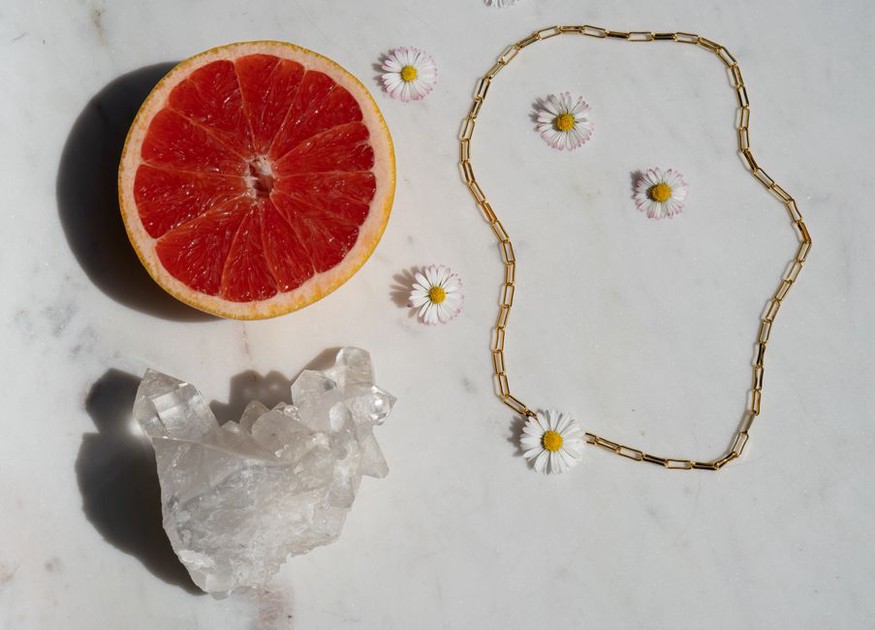
The pendant on the Store P628 Summer of Love Necklace is a small enamel disc, no larger than a ten-pence coin, painted with a daisy whose petals shimmer in pale yellow and white. A thin brass chain, tarnished to a gentle bronze, holds it at a length that falls just below the collarbone. This is not a piece of fine jewellery in the traditional sense — it was never meant to be. It is a tangible scrap of 1967, when London’s boutiques on the King’s Road filled their windows with cheap, joyful accessories that spoke of peace, love, and a rebellion against the starched formality of the previous decade.
The necklace carries the catalogue code Store P628, a designation that places it in a small series of accessories produced by a now-defunct British manufacturer whose archives are scattered among private collectors. The “Summer of Love” name is not a marketing invention — it is stamped on the inside of the clasp, a tiny inscription that reminds us how openly the era labelled its own spirit. The brass base is unplated, the enamel hand-painted, and the clasp is a simple hook-and-eye that requires a steady hand to fasten. These details are what make the piece both fragile and precious.

Wearing the Summer of Love Necklace as a Hair Accessory
At first glance, this necklace seems destined for a décolletage. Yet the lightness of the chain and the small size of the pendant make it an ideal candidate for a hair transformation. The trick is to treat the chain as a flexible hair band rather than a necklace. Try these three approaches:
- As a low ponytail wrap. Gather your hair into a low ponytail, then wrap the necklace around the elastic band two or three times. Let the daisy pendant rest at the nape of your neck, where it will peep out between strands. The chain’s slight weight keeps it in place without pulling.
- As a side-swept head chain. Part your hair deeply on one side. Drape the necklace across your forehead, just above the eyebrows, and secure the clasp at the back of your head. Tuck a few front strands over the chain to create a look that says you’ve been wearing it all day, not just for the photo. This works best with medium to long hair and a little texture spray.
- As a braid accent. French-braid your hair from the crown, but before you start, clip the necklace to the top of the braid with a small bobby pin. As you braid, let the chain hang loose so it becomes woven into the plait. The pendant will dangle at the end of the braid like a tiny charm.
For a similar approach to head-worn accessories, our guide to the Store P296 Maison Archives Velvet Braided Crown Headband explores how velvet and brass can be combined for a vintage evening look. The Summer of Love necklace, in contrast, belongs to a more carefree, daytime aesthetic.
Materials and Construction: What Makes It Unique
The chain is a simple trace-link pattern, each link about 2 mm in diameter. The brass has no plating, so it oxidises naturally. The enamel is not translucent — it is a solid opaque layer, applied by hand over a recessed design. The daisy motif is outlined with a fine incised line, and the centre of the flower is a tiny dot of brighter yellow. The clasp is a hand-soldered hook, which is the weakest point of the piece. Many surviving examples have had the clasp replaced or repaired.
The pendant itself is a disc with a slightly raised edge, reminiscent of the “flower power” badges sold at the 1967 International Festival of the Flower Children in Hyde Park. The necklace’s small scale — total length 45 cm, pendant diameter 1.8 cm — means it was almost certainly designed for a young woman or teenager. That cheapness is what made it accessible to the teenagers who bought it off the King’s Road.
Caring for the Vintage Brass Chain
Because the brass is unplated, it will continue to darken with exposure to air and skin oils. This is not damage — it is the natural patina of a material that is alive. To maintain the chain’s original brightness, wipe it gently with a soft, dry cloth after each wear. Never use liquid jewellery cleaner, as it can seep under the enamel and lift it. For deeper cleaning, a dry microfibre cloth is sufficient. If the chain becomes kinked, do not pull it straight — instead, coax it back into shape by running it through your fingers slowly, link by link.
The enamel is fragile. Avoid dropping the necklace onto hard surfaces, and store it flat in a fabric-lined box, not hanging, because the weight of the chain can stretch the clasp over time. If you wear it as a hair accessory, be mindful of hairspray or dry shampoo: these products can leave a residue on the chain and dull the enamel. Apply styling products before putting the necklace in your hair, not after.
Collecting Context: Where the Summer of Love Necklace Sits
The Store P628 piece belongs to a small group of British accessories from the late 1960s that used inexpensive materials — brass, enamel, plastic — to create bold, graphic statements. It is not rare in the sense of being one of a kind, but it is uncommon because the enamel was prone to chipping and the chain to breaking. Collectors today look for examples with intact enamel and an original clasp. The patina is almost always present, and a uniform darkening across the whole chain is a sign of authenticity.
For a contrast in mid-century material and silhouette, the Bettie Lurex Triangle Clip Barrette shows how the 1950s used metallic threads and structured shapes, while the 1960s embraced soft curves and organic motifs. The Summer of Love necklace, with its daisy and freeform chain, is the polar opposite of that earlier precision.
When you hold this necklace, you are holding a piece of a summer that was supposed to change the world. It did, in small ways — in the way we dress, in the way we accessorise, and in the permission we give ourselves to wear a daisy in our hair, even if that daisy is made of brass and enamel and hangs from a chain that used to be a necklace.