
The Ruby Finola: A Rare Mid-Century British Hair Clip Worth Knowing
The Store p558 Ruby Finola is a rare mid-century British hair clip. Its deep ruby colour shifts from garnet to cranberry depending on the light. Produced in limited quantities between 1953 and 1958, it rarely appears in vintage markets today. For collectors familiar with the Maison Archives catalogues, the Ruby Finola is a variant that was made in small batches, and understanding its construction, material composition, and place within the broader Finola family is essential for anyone serious about building a representative collection of British mid-century hair jewellery.
What Makes the Ruby Finola Distinctive
The Ruby Finola belongs to a small series of clips named after the same pattern — a gently scalloped silhouette with a subtle leaf-like contour along the top edge. What sets this particular piece apart is not the shape but the colour and the way it was achieved. The ruby hue is not a surface dye but a tint suspended within the cellulose acetate itself, a technique that gives the clip a luminous depth. When held up to natural light, the material reveals faint organic swirls, evidence of the hand-pouring and curing process that characterised small-batch production in post-war Britain.
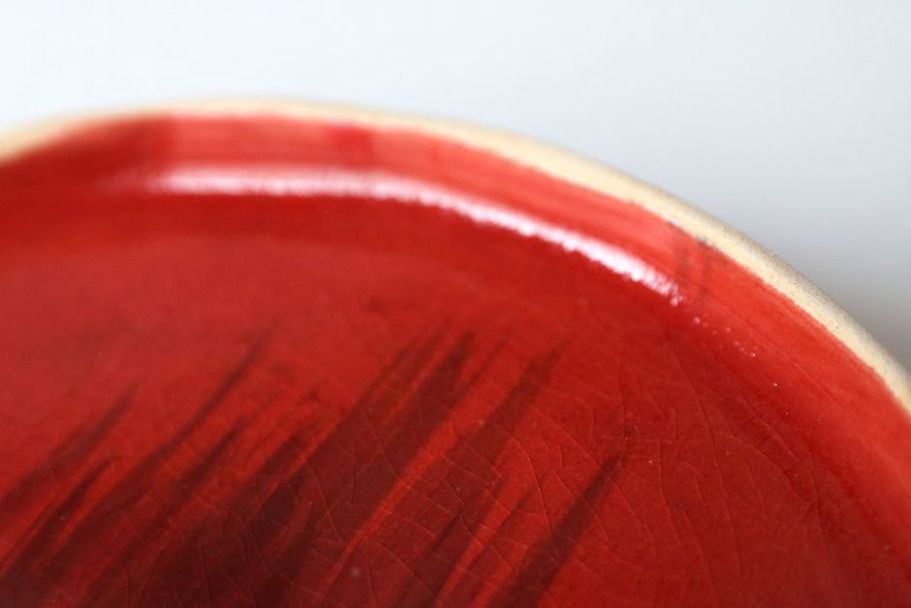
The clip measures approximately 7.5 cm in length and 2 cm at its widest point — a size that was considered practical for everyday wear yet substantial enough to hold a section of hair securely. The spring mechanism is a simple pinch-clasp of nickel-plated steel, typical of the period, and on well-preserved examples it still opens and closes with a satisfying, firm snap. The reverse side is unmarked, which is common for pieces that were sold through independent department stores rather than through branded packaging.
Material and Craftsmanship
Cellulose acetate was the material of choice for many British hair accessory makers in the 1940s and 1950s. It was lightweight, warm to the touch, and could be polished to a high gloss that resembled early plastics like Bakelite but without the brittleness. The Ruby Finola was made from a specific formulation that included a red lake pigment — a type of organic dye that was stable and did not fade easily. This is why surviving examples still retain their deep colour after seven decades, provided they have been kept away from prolonged direct sunlight.
The finishing work is where the craftsmanship becomes evident. The edges are smoothly bevelled, with no sharp transitions between the face and the sides. The scalloped pattern was cut using a steel die, then hand-buffed on a felt wheel to achieve a soft, rounded profile. The result is a clip that feels comfortable against the scalp and does not snag fine hair — a detail that mid-century manufacturers took seriously, as many women styled their hair daily with such accessories.
Dating the Ruby Finola
Pinpointing the exact production year of a specific Ruby Finola clip requires examining several clues. The most reliable indicator is the clasp design. Early examples from the late 1940s used a simpler, narrower spring, while clips from the mid-1950s onward feature a wider, more robust hinge with a small reinforcing ridge at the pivot point. The Ruby Finola consistently shows the later clasp, placing it firmly in the 1953–1958 window. Additionally, the colour saturation — a deep, even ruby with no streaks — suggests a production run that occurred after manufacturers had refined their pigment-dispersion techniques.
| Feature | Ruby Finola (c. 1953–1958) | Earlier Finola Variant (c. 1948–1952) |
|---|---|---|
| Material | Cellulose acetate with red lake pigment | Cellulose acetate with surface-dyed finish |
| Clasp type | Wide hinge with reinforcing ridge | Narrow spring without ridge |
| Colour behaviour | Even saturation, translucent in light | Occasional mottling, opaque |
| Surface finish | High gloss, hand-bevelled edges | Matte or semi-gloss, machine-polished |
How to Identify an Authentic Ruby Finola
Because the Ruby Finola is relatively rare, reproductions and misidentified clips do appear on online marketplaces. Here are practical checks you can perform without specialised equipment:
- Weight test: Genuine cellulose acetate is lighter than modern acrylic. An authentic Ruby Finola feels almost hollow in the hand, whereas a modern copy will have a denser, more plasticky heft.
- Surface temperature: Acetate warms quickly to the touch. If the clip feels cold and stays cold, it may be a different material.
- Odour: When rubbed firmly with a dry finger, vintage cellulose acetate sometimes releases a faint, sweetish smell — reminiscent of old movie film. Modern plastics do not produce this odour.
- Edge wear: Look for tiny, rounded chips along the scalloped edge. Genuine age shows as micro-abrasions that blend into the surface, not as sharp, white cracks.
For a deeper understanding of how mid-century British hair clips were constructed and how to evaluate their condition, the article on The Emoji Organic Basket: A 1970s Hair Accessory Rediscovered offers a parallel look at material degradation and preservation techniques that apply equally to the Ruby Finola.
Styling the Ruby Finola with a Modern Wardrobe
The deep ruby colour is surprisingly versatile. It works beautifully as a focal point against neutral tones — cream, charcoal, navy, or olive — and it echoes the jewel-toned accessories that are currently favoured in British fashion circles. For daytime wear, the clip can be used to secure a low, loose side-sweep, allowing the scalloped edge to catch the light. For evening, it pairs well with velvet collars and structured blazers, offering a touch of mid-century polish without feeling costume-like.

One approach that collectors particularly appreciate is to let the clip stand alone rather than combining it with other hair accessories. The Ruby Finola has enough visual weight to act as a statement piece on its own. If you do wish to layer, consider a simple velvet headband in a complementary shade — the P297 Velvet Crown Headband: A Collector's Guide to Mid-Century British Millinery provides practical advice on selecting headbands that harmonise with vintage clips without competing for attention.
Caring for Your Ruby Finola
Cellulose acetate is sensitive to heat, humidity, and prolonged light exposure. To keep your Ruby Finola in its best possible condition, store it flat in a fabric-lined box or a drawer away from radiators and direct sunlight. Never use acetone or alcohol-based cleaners; they will dissolve the surface. Instead, wipe the clip gently with a soft, dry cloth after each wear. If the clasp becomes stiff, a tiny drop of sewing machine oil applied to the hinge with a toothpick can restore smooth movement — but avoid getting oil on the acetate itself.
Should the surface develop a light haze over time, a very gentle polish with a microfiber cloth can restore some of its original gloss. Avoid commercial plastic polishes, as many contain abrasive compounds. The goal is to preserve the patina of age, not to make the piece look brand new. A Ruby Finola that shows gentle wear tells a story of seven decades of careful use, and that narrative is part of its value.
When you do find a Ruby Finola at a vintage fair, expect to pay between £40 and £80 depending on condition. Check the clasp first — if it's the wide hinge with reinforcing ridge, you've likely found an authentic piece from the 1953–1958 run. The colour should be even and translucent when held up to light, with no surface scratches that cut through the gloss. That combination of clues is your best bet for a genuine find.