
Products Meena: The Art of Enamel Hair Accessories in British Vintage Fashion
On a grey Saturday morning at a vintage fair in Brighton, I spotted a small tortoiseshell comb with a delicate floral pattern in vivid blues and greens. The seller, an elderly woman with a stack of bakelite bangles, called it ‘Meena work’. She explained that the word came from the Hindi mīnā, meaning enamel, and that these pieces were once imported into Britain from India during the 1960s and 1970s. That comb cost me twelve pounds, and it taught me a new way of looking at vintage hair accessories.
Meena, in the context of hair adornments, refers to a specific enamelling technique traditionally used on brass, copper, or silver. A fine metal base is engraved with a pattern, then filled with coloured glass powder and fired at high temperatures. The result is a smooth, durable surface that feels almost like polished stone. In British vintage shops, you rarely see the word ‘Meena’ on a label, but the pieces are unmistakable once you know what to look for — a glossy, slightly raised floral or geometric motif, often set into a hair clip or a decorative comb.
A Brief History of Meena in British Hair Fashion
India has a long tradition of enamelled jewellery, and the technique arrived in Britain through colonial trade routes and later through the countercultural movements of the 1960s. As young British women began to embrace ethnic prints, kaftans, and Indian jewellery, enamelled hair accessories naturally followed. Small independent boutiques in London’s Carnaby Street and Kensington Market stocked these pieces, often alongside the Nina headband and other imported styles. The appeal was twofold: the vivid colours were unlike anything produced in British factories, and the handcrafted nature gave each piece a unique character.
By the 1970s, Meena combs and clips had become a staple of the boho-chic wardrobe. They were worn with centre-parted hair, often tucked into a low bun or used to hold back a headscarf. The most common shapes were half-moon combs, rectangular barrettes, and small tortoiseshell-style clips with an enamelled centre panel. Today, these pieces are highly collectable, not least because the enamel can chip or crack over time, making pristine examples increasingly rare.
Materials and Techniques: What Makes a Meena Hair Accessory
Authentic Meena work starts with a metal base. In vintage pieces, the base is usually brass or copper, occasionally silver for higher-end items. The metal is first shaped into the desired form — a comb, a clip, a hair slide — then the surface is engraved with a design. The engraving creates tiny channels that will hold the enamel. Coloured glass powder, mixed with a flux, is applied and the piece is fired in a kiln. The enamel melts and fuses to the metal, forming a hard, glossy coating. This process may be repeated several times to build up layers of colour.
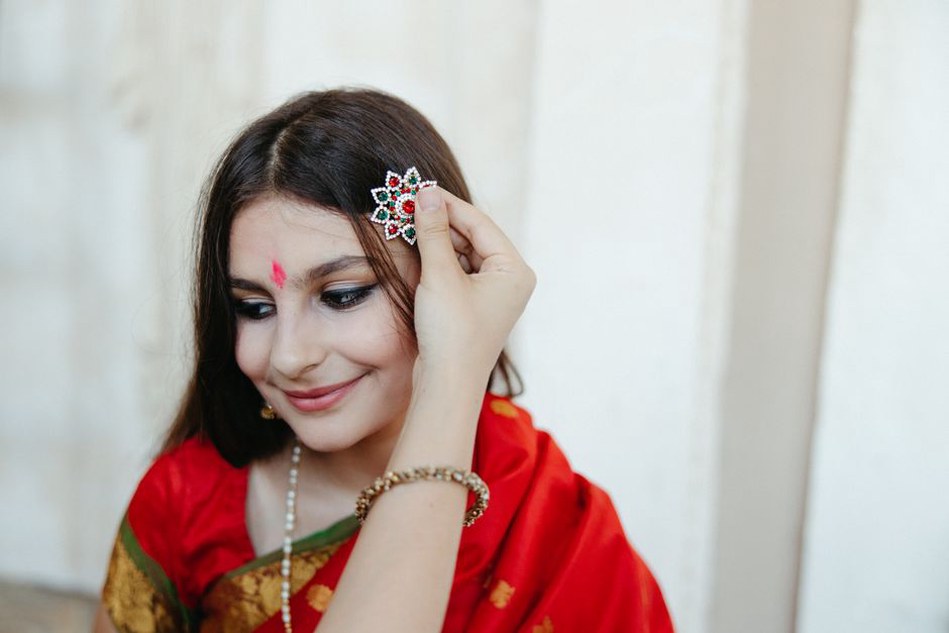
Characteristic features of Meena hair accessories include:
- Raised enamel: The coloured areas stand slightly above the metal surface, unlike painted designs which are flat.
- Little to no visible brushstrokes: Enamel is a glass-like material, so the surface is smooth and even.
- Metal backing: The reverse side of the piece is usually plain metal, often with a slight patina or tarnish.
- Handmade irregularities: Slight variations in colour intensity or tiny air bubbles are signs of authentic craftsmanship.
Modern reproductions often use cold enamel (a resin that hardens without heat) or simple paint. Cold enamel feels softer and can be scratched with a fingernail, whereas fired enamel is hard as glass. If you are unsure, hold the piece under a bright light — genuine Meena will have a deep, translucent glow, not a flat, opaque look.
Iconic Silhouettes from the 20th Century
Meena decoration was applied to several classic hair accessory shapes. The most collectable are the large half-moon combs, often worn at the back of the head to hold an updo. These combs can be up to four inches wide and are decorated with a central floral motif. Another popular silhouette is the French barrette — a long, hinged clip with a Meena panel on the top. These are especially sought after in shades of turquoise, coral, and deep green, colours that were fashionable in the 1960s and 1970s.
Smaller pieces include the ‘hair slide’ — a flat clip with a spring mechanism — and decorative hairpins topped with a single enamelled bead or flower. The bead style is often mistaken for glass, but a close look reveals the metal base underneath. For collectors, the condition of the enamel is paramount. Chips dramatically reduce value, but a hairline crack that does not affect the structural integrity may be acceptable if the piece is rare.
Where to Find Genuine Vintage Meena Accessories
Britain’s vintage fairs and charity shops are still good hunting grounds. Look in boxes labelled ‘costume jewellery’ or ‘accessories’ — Meena pieces often get lumped together with other imports. Online marketplaces can be useful, but require caution. Search for terms like ‘enamel hair comb’, ‘Indian hair clip’, or ‘vintage Meena’, and always ask for a clear photo of the back. The metal back should show signs of age, such as tarnish or wear, and the enamel should not have a perfectly uniform colour — slight variations are a good sign.
One of the joys of collecting Meena is that these pieces are still affordable compared to designer vintage. A decent comb can cost between £15 and £40, while a rare barrette with intricate floral work might reach £80. The key is to buy what you love and not worry too much about authentication — if the enamel feels hard and cold, and the colours are vibrant, you have likely found a genuine piece.
Styling Meena with a Modern Wardrobe
Meena hair accessories can look surprisingly contemporary. A single enamel comb worn at the nape of the neck adds a touch of colour to a simple white shirt and jeans. For evenings, a large barrette with a jewel-toned Meena panel can be the focal point of an otherwise minimal outfit. The trick is to let the accessory speak — avoid competing patterns or bright scarves. Pair with neutral colours like cream, navy, or black, and let the enamel’s lustre shine.
Another modern approach is to combine Meena with other vintage pieces, such as a hot pink Caroline turban headband, for a layered, curated look. The key is balance: one statement piece per zone. If you wear a Meena comb, keep earrings simple and small.
Caring for Meena Hair Accessories
Enamel is durable but can chip if dropped or knocked against hard surfaces. Store your Meena pieces separately in a soft pouch or a lined jewellery box. Avoid exposing them to water, perfume, or hairspray, as these can dull the enamel over time. To clean, gently wipe with a soft, dry cloth. If the metal back has tarnish, use a silver polishing cloth on the metal only, being careful not to touch the enamel. Never use abrasive cleaners or soak the piece in liquid.
If you find a piece with a small chip, you can still wear it — just be aware that the chip may grow. Some collectors choose to have chipped enamel professionally restored, but this is expensive and often not worth it for less rare pieces. For a minor crack, a thin layer of clear nail polish can seal the surface, but this is a temporary fix and should only be done if you plan to wear the piece regularly.
For your next trip to a vintage fair, take a small magnifying glass and a soft cloth. Look for the telltale glassy shine, the slight unevenness of a handmade piece, and the warmth of colours that have survived decades. A Meena hair accessory is not just a beautiful object — it is a small piece of cross-cultural history, waiting to be rediscovered and worn again.